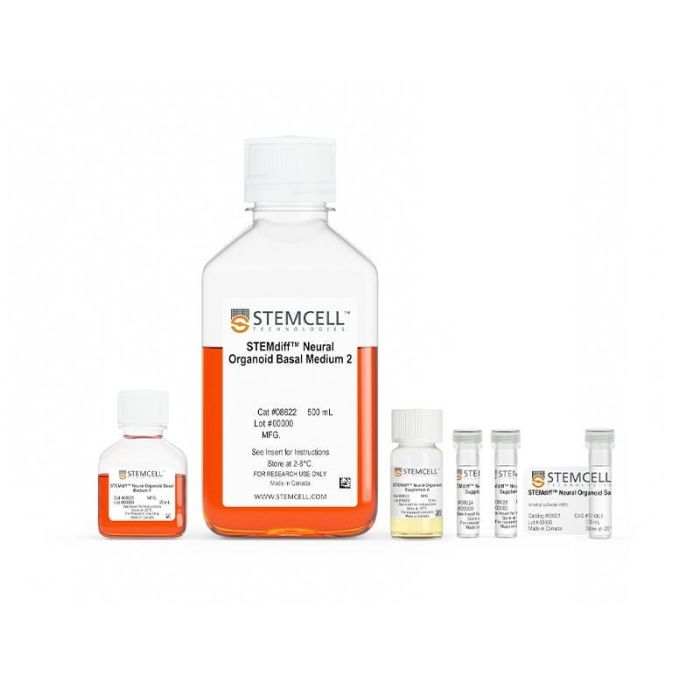
产品号 #08630_C
用于从人多能干细胞高效生成腹侧前脑神经类器官的细胞培养基试剂盒
若您需要咨询产品或有任何技术问题,请通过官方电话 400 885 9050 或邮箱 info.cn@stemcell.com 与我们联系。
用于从人多能干细胞高效生成腹侧前脑神经类器官的细胞培养基试剂盒
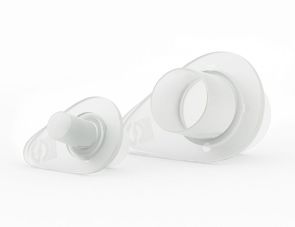
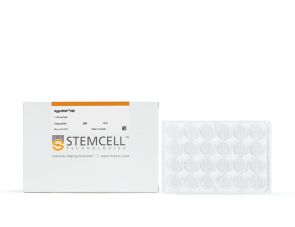
使用STEMdiff™腹侧前脑类器官分化试剂盒,从人多能干细胞中高效稳定地生成定向神经类器官。与AggreWell™ 800配合使用时,这种无基质、无血清的细胞培养基试剂盒可支持每个试剂盒生成200个或更多类器官,从而用于更高效的纵向研究。
本试剂盒通过基于Sergiu Paşca(Birey et al., 2017)的实验方案生成脑区特异性类器官,是具有人类前脑发育特征的三维体外模型,具有代表性的细胞组成和结构组织。这些类器官在不同细胞系之间具有一致的尺寸和可重复的形态,为在功能性三维系统中研究抑制性中间神经元提供了可靠模型。
STEMdiff™腹侧前脑类器官分化试剂盒可生成早期发育的腹侧大脑皮层下组织,而STEMdiff™背侧前脑类器官分化试剂盒生成早期发育的背侧大脑皮层组织。使用这些试剂盒生成的类器官也可以作为组装体共培养,以研究脑区间的相互作用(Birey et al., 2017)。对于需要长期培养(>50天)的类器官,其维持培养所需的成分可通过STEMdiff™神经类器官维持培养试剂盒获得。
分类
专用培养基
细胞类型
神经细胞,PSC衍生,神经干/祖细胞,多能干细胞
种属
人
应用
细胞培养,鉴定,分化,功能学筛选,免疫荧光,类器官培养,表型鉴定,球状体培养
品牌
STEMdiff
研究领域
疾病建模,药物发现和毒理检测,神经科学,类器官
制剂类别
无血清

Figure 1. Schematic for the STEMdiff™ Ventral Forebrain Organoid Differentiation Kit
hPSC-derived ventral forebrain organoids can be generated in 43 days. Embryoid bodies can be created in 6 days with AggreWell™800 plates. The EBs are then cultured in suspension, allowing growth and subsequent patterning to the ventral forebrain. For the long-term maintenance and further maturation of ventral forebrain organoids, see the PIS. hPSC = human pluripotent stem cell; EBs = embryoid bodies.
Figure 2. STEMdiff™ Ventral Forebrain Organoid Differentiation Kit Supports the Generation of Homogeneous Organoids
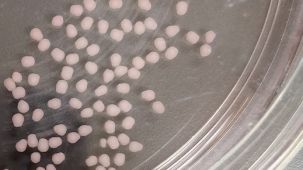
(A) Neural aggregates formed in AggreWell™800 microwell plates exhibit uniform size and shape at day 6. H9-derived ventral forebrain organoids from a single batch have spherical morphology at days (B) 15 (C) 25 (D) 50 (E) 75 and (F) 100. Scale bar = 1 mm. (G) Ventral forebrain organoids exhibit homogeneous size over multiple cell lines (average ± SD, using 11 cell lines with 3 - 5 organoids counted per cell line and time point).
Figure 3. STEMdiff™ Dorsal and Ventral Forebrain Organoid Differentiation Kits Reduce Unwanted Organoid Fusion
Whole-well images of dorsal forebrain organoid cultures derived from the H9 cell line in STEMdiff™ Forebrain Organoid Expansion Medium (bottom row) vs. the control published formulation (top row) show the extent of fusion typical in control media without orbital shaking. At Day 10 post-seeding in the control formulation, 12/12 organoids that were seeded are developing, but by Day 20 a single, larger organoid can be seen in the well. In STEMdiff™ Forebrain Organoid Expansion Medium, 20/20 seeded organoids are developing and 20/20 are still developing at Day 20 without shaking. While organoids in both culture conditions grow larger between 10 and 20 days, the reduction in organoids and enlarged size in the control formulation suggest a reduction in organoid yield due to organoid fusion.
Figure 4. Ventral Forebrain Organoids Exhibit Brain-Region-Specific Marker Expression as They Mature
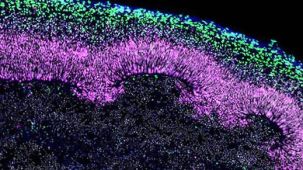
(A) Ventral forebrain organoids at day 25 exhibit a high level of expression of NKX2.1 (magenta; DAPI, gray). (B) NKX2.1-positive neurons (magenta; DAPI, cyan) are plentiful by Day 50 (DAPI, cyan), but Somatostatin-positive GABAergic interneurons (SST, green) are rare. (C) By day 75, SST-positive interneurons (green; NKX2.1, magenta) are observable.
Figure 5. Neural Organoids Generated with STEMdiff™ Dorsal and Ventral Forebrain Organoid Kits Express Key Markers of Brain-Region-Specific Patterning
RNA from single organoids was harvested at a series of time points and subsequently assayed using bulk RNA-seq (1 data column = 1 organoid). (A) Heat map of select genes shows that both dorsal forebrain organoids (DFO) and ventral forebrain organoids (VFO) express the forebrain-specific marker FOXG1 while showing a shift from neural progenitor fates to neuronal cell types. (B) DFO express increasing levels of cortex- and glutaminergic neuron-specific genes from day 25 to 75. (C) Day 25 VFO exhibit high expression of markers of the medial ganglionic eminence and of GABAergic neurons. Heat map scale quantifies gene expression across each row with a normalized z-score for each gene.
Figure 6. Dorsal Forebrain Organoids, Not Ventral Forebrain Organoids, Display Early Network Bursting Activity
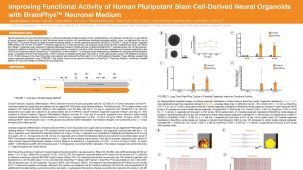
Day 50 dorsal and ventral forebrain organoids were plated on a microelectrode array (MEA; CytoView MEA 96, Axion Biosystems) coated with 0.1% polyethyleneimine in borate buffer and 20 µg/mL CellAdhere™ Laminin-521. Activity from 8 electrodes per well was recorded once per week for 4 weeks using a Maestro MEA system (Axion Biosystems). (A) Representative bright field image of dorsal and ventral forebrain organoids on the MEA. Insets show representative spike rate heat maps for the corresponding well (red = 12 spikes/sec). Scale bar = 1 mm. (B) Raster plots of spike activity show increasing network bursting (pink lines) for dorsal forebrain organoids between week 1 and week 4, whereas no network bursting is observed in the ventral forebrain organoid (lower panels) over the same time period. (C) Mean firing rate (average ± SEM; 3 - 6 organoids per time point) increases for dorsal forebrain organoids but not ventral forebrain organoids over 4 weeks of measurements.
Figure 7. Fluorescent Imaging in BrainPhys™ Imaging Optimized Medium Improves Signal-to-Background Ratios of 3D Neural Cultures
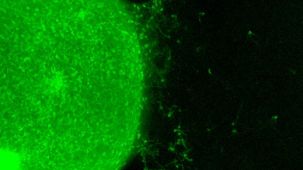
GFP-labeled ventral forebrain organoids were co-cultured and merged with unlabeled dorsal forebrain organoids for one week prior to live imaging in Forebrain Organoid Differentiation Medium from STEMdiff™ Dorsal Forebrain Organoid Differentiation Kit (right) or BrainPhys™ Imaging Optimized Medium (BPI, left). Interneuron migration can be visualized more clearly in BPI. Scale bar top panels = 300μm; scale bar bottom = 100μm. Adapted from Zabolocki et al. 2020, Nature Communications, available under a Creative Commons 4.0 License. For experimental details on generating AssemBloids™ from dorsal and ventral forebrain organoid co-cultures, see the protocol in our Methods Library.
Figure 8. Neural Organoids Generated with STEMdiff™ Ventral Forebrain Organoid Differentiation Kit Contain Ventral Cell Populations
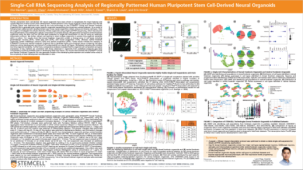
Guided ventral forebrain organoids were generated from H9 ESCs using STEMdiff™ Ventral Forebrain Organoid Differentiation Kit. scRNA-seq gene expression data captures the cellular diversity of these neural organoids which can be further explored using the Single Cell RNA Sequencing Data Visualization Tool for Neural Organoids. At Day 50, the organoids were dissociated into a single-cell suspension. The library was prepared using Chromium Single Cell 3ʹ v1 protocol with Feature Barcoding technology (10x Genomics) following surface protein staining with TotalSeq™–B (BioLegend). The barcoded processing, gene counting and aggregation were done using the Cell Ranger software v3.1.0. Further processing and demultiplexing was done with Seurat v4.1.1. The data have been made publicly available on GEO: GSE218457. ESC = embryonic stem cell
请在《产品说明书》中查找相关支持信息和使用说明,或浏览下方更多实验方案。
本产品专为以下研究领域设计,适用于工作流程中的高亮阶段。探索这些工作流程,了解更多我们为各研究领域提供的其他配套产品。
Thank you for your interest in IntestiCult™ Organoid Growth Medium (Human). Please provide us with your contact information and your local representative will contact you with a customized quote. Where appropriate, they can also assist you with a(n):
Estimated delivery time for your area
Product sample or exclusive offer
In-lab demonstration
| 物种 | 人 |
|---|---|
| 配方 | 无血清 |
提升神经元功能的无血清基础培养基

用于人脑类器官建立与成熟的培养基试剂盒
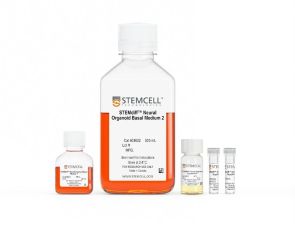
用于从人多能干细胞高效生成背侧前脑神经类器官的细胞培养基试剂盒
质量声明:
产品仅供研究使用,不用于针对人或动物的诊断或治疗。 欲获悉更多关于STEMCELL的质控信息,请访问 STEMCELL.CN/COMPLIANCE.
扫描二维码或搜索微信号STEMCELLTech,即可关注我们的微信平台,第一时间接收丰富的技术资源和最新的活动信息。
如您有任何问题,欢迎发消息给STEMCELLTech微信公众平台,或与我们通过电话/邮件联系:400 885 9050 INFO.CN@STEMCELL.COM。
在线联系