若您需要咨询产品或有任何技术问题,请通过官方电话 400 885 9050 或邮箱 info.cn@stemcell.com 与我们联系。

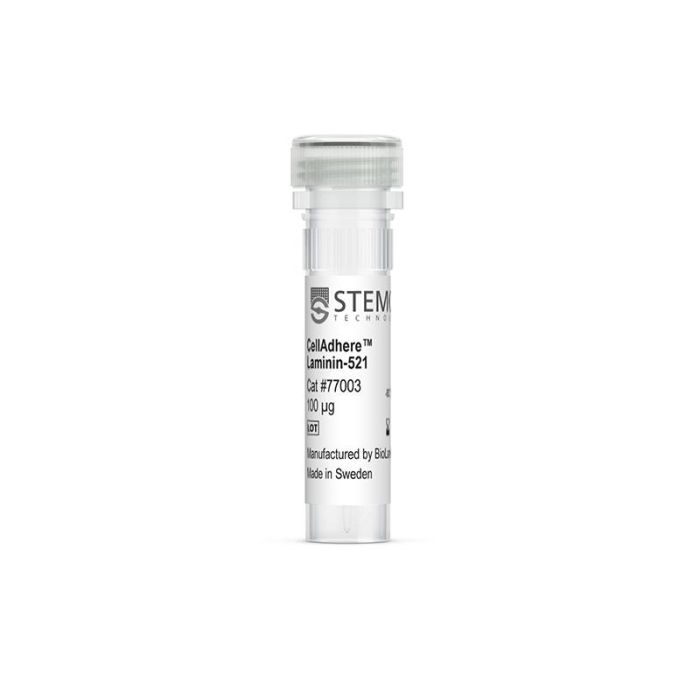
CellAdhere™ Laminin-521

与 TeSR™ 维持培养基配合使用,用于维持人胚胎干细胞(ES)和诱导多能干细胞(iPS)的基质
只有 %1
¥2,018.00

产品号 #(选择产品)

产品号 #77003_C

与 TeSR™ 维持培养基配合使用,用于维持人胚胎干细胞(ES)和诱导多能干细胞(iPS)的基质

产品优势

  • 采用重组人源蛋白基质,减少实验中的可变因素
  • 传代时无需使用抗凋亡抑制剂
  • 可与任何TeSR™系列培养基一起使用以维持hPSCs
  • 搭配 eTeSR™ 进行单细胞传代时,提高单细胞的黏附率和存活率
  • 利用这种生理相关基质模拟干细胞微环境

总览


为了在下游应用中获得一致的细胞群体和可重复的结果,推荐将 CellAdhere™™Laminin-521与TeSR™维持培养基联合使用,为细胞维持提供成分确定的培养基质。Laminin-521是由人多能干细胞(hPSCs)在胚胎内细胞团中表达和分泌的,因此可在体外构建具有生物学相关性的 hPSC 培养环境。CellAdhere™ Laminin-521可与eTeSR™(产品号# 100 - 1215)维持培养基联合使用进行单细胞传代。与其他基质相比,CellAdhere™ Laminin-521 能提高单细胞的黏附率和存活率,且在长期培养过程中无需添加抗凋亡抑制剂。常规 PSC 聚集体传代可配合使用温和细胞分离试剂(GCDR)产品号# 07174)或ReLeSR™(产品号# 05872),进行单细胞传代时可使用Accutase™(产品号# 07920)。

人ES和iPS细胞的单细胞传代可能会产生选择压力,从而引起遗传异常。如果采用单细胞传代,建议定期进行核型检测。

细胞类型
多能干细胞
 
种属

 
品牌
CellAdhere
 

产品说明书及文档

请在《产品说明书》中查找相关支持信息和使用说明,或浏览下方更多实验方案。

Document Type
Product Name
Catalog #
Lot #
Language
Catalog #
77003, 200-0117
Lot #
All
Language
English
Document Type
Safety Data Sheet
Catalog #
77003
Lot #
All
Language
English
Document Type
Safety Data Sheet
Catalog #
200-0117
Lot #
All
Language
English

应用领域

本产品专为以下研究领域设计,适用于工作流程中的高亮阶段。探索这些工作流程,了解更多我们为各研究领域提供的其他配套产品。

相关材料与文献

技术资料 (10)

文献 (9)

Recurrent gain of chromosomes 17q and 12 in cultured human embryonic stem cells. Draper JS et al. Nature biotechnology 2004 JAN

Abstract

We have observed karyotypic changes involving the gain of chromosome 17q in three independent human embryonic stem (hES) cell lines on five independent occasions. A gain of chromosome 12 was seen occasionally. This implies that increased dosage of chromosome 17q and 12 gene(s) provides a selective advantage for the propagation of undifferentiated hES cells. These observations are instructive for the future application of hES cells in transplantation therapies in which the use of aneuploid cells could be detrimental.
Screening ethnically diverse human embryonic stem cells identifies a chromosome 20 minimal amplicon conferring growth advantage. Amps K et al. Nature biotechnology 2011 DEC

Abstract

The International Stem Cell Initiative analyzed 125 human embryonic stem (ES) cell lines and 11 induced pluripotent stem (iPS) cell lines,from 38 laboratories worldwide,for genetic changes occurring during culture. Most lines were analyzed at an early and late passage. Single-nucleotide polymorphism (SNP) analysis revealed that they included representatives of most major ethnic groups. Most lines remained karyotypically normal,but there was a progressive tendency to acquire changes on prolonged culture,commonly affecting chromosomes 1,12,17 and 20. DNA methylation patterns changed haphazardly with no link to time in culture. Structural variants,determined from the SNP arrays,also appeared sporadically. No common variants related to culture were observed on chromosomes 1,12 and 17,but a minimal amplicon in chromosome 20q11.21,including three genes expressed in human ES cells,ID1,BCL2L1 and HM13,occurred in textgreater20% of the lines. Of these genes,BCL2L1 is a strong candidate for driving culture adaptation of ES cells.
A defined xeno-free and feeder-free culture system for the derivation, expansion and direct differentiation of transgene-free patient-specific induced pluripotent stem cells Lu HF et al. Biomaterials 2014 MAR

Abstract

A defined xeno-free system for patient-specific iPSC derivation and differentiation is required for translation to clinical applications. However,standard somatic cell reprogramming protocols rely on using MEFs and xenogeneic medium,imposing a significant obstacle to clinical translation. Here,we describe a well-defined culture system based on xeno-free media and LN521 substrate which supported i) efficient reprogramming of normal or diseased skin fibroblasts from human of different ages into hiPSCs with a 15-30 fold increase in efficiency over conventional viral vector-based method; ii) long-term self-renewal of hiPSCs; and iii) direct hiPSC lineage-specific differentiation. Using an excisable polycistronic vector and optimized culture conditions,we achieved up to 0.15%-0.3% reprogramming efficiencies. Subsequently,transgene-free hiPSCs were obtained by Cre-mediated excision of the reprogramming factors. The derived iPSCs maintained long-term self-renewal,normal karyotype and pluripotency,as demonstrated by the expression of stem cell markers and ability to form derivatives of three germ layers both in vitro and in vivo. Importantly,we demonstrated that Parkinson's patient transgene-free iPSCs derived using the same system could be directed towards differentiation into dopaminergic neurons under xeno-free culture conditions. Our approach provides a safe and robust platform for the generation of patient-specific iPSCs and derivatives for clinical and translational applications. textcopyright 2013 Elsevier Ltd.

更多信息

更多信息
物种
质量保证:

产品仅供研究使用,不用于针对人或动物的诊断或治疗。 欲获悉更多关于STEMCELL的质控信息,请访问 STEMCELL.CN/COMPLIANCE.
Copyright © 2026 by STEMCELL Technologies. All rights reserved.

在线联系