若您需要咨询产品或有任何技术问题,请通过官方电话 400 885 9050 或邮箱 info.cn@stemcell.com 与我们联系。

RosetteSep™人间充质干细胞富集抗体混合物

为血浆和密度梯度离心液的交界界面中高度富集的细胞。
只有 %1
¥2,310.00

产品号 #(选择产品)

产品号 #15128_C

为血浆和密度梯度离心液的交界界面中高度富集的细胞。

产品优势

  • 快捷、操作简单
  • 不需要特殊设备或额外培训
  • 获得的活细胞无标记

产品组分包括

  • RosetteSep™人间充质干细胞富集抗体混合物(产品号#15128)          
    • RosetteSep™人间充质干细胞富集抗体混合物,2mL
  • RosetteSep™人间充质干细胞富集抗体混合物(产品号#15168)          
    • RosetteSep™人间充质干细胞富集抗体混合物操作流程,5x2mL
专为您的实验方案打造的产品
要查看实验方案所需的所有配套产品,请参阅《实验方案与技术文档》

总览

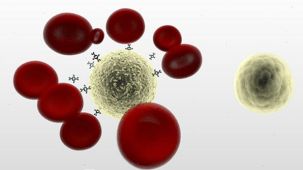
RosetteSep™人间充质干细胞富集抗体混合物通过负选从新鲜骨髓分离间充质干细胞。四聚体抗体复合物可识别CD3、CD14、CD19、CD38、CD66b以及红细胞(RBC)上的糖蛋白A,从而靶向去除非目的细胞。使用密度梯度离心液如Lymphoprep™(产品号 #18060)离心后 ,非目的细胞会与红细胞一起沉淀。纯化的间充质干细胞为血浆和密度梯度离心液的交界界面中高度富集的细胞。

分类
细胞分选试剂盒
 
细胞类型
间充质干/祖细胞
 
种属

 
样本来源
骨髓
 
分选方法
负选
 
应用
细胞分选
 
品牌
RosetteSep
 
研究领域
药物发现和毒性检测,干细胞生物学
 

产品说明书及文档

请在《产品说明书》中查找相关支持信息和使用说明,或浏览下方更多实验方案。

Document Type
Product Name
Catalog #
Lot #
Language
Document Type
产品说明书
Catalog #
15128
Lot #
All
Language
中文
Document Type
产品说明书
Catalog #
15168
Lot #
All
Language
中文
Catalog #
15168, 15128
Lot #
All
Language
English
Document Type
Safety Data Sheet
Catalog #
15168, 15128
Lot #
All
Language
English

应用领域

本产品专为以下研究领域设计,适用于工作流程中的高亮阶段。探索这些工作流程,了解更多我们为各研究领域提供的其他配套产品。

相关材料与文献

技术资料 (4)

常见问题

What is RosetteSep™?

RosetteSep™ is a rapid cell separation procedure for the isolation of purified cells directly from whole blood, without columns or magnets.

How does RosetteSep™ work?

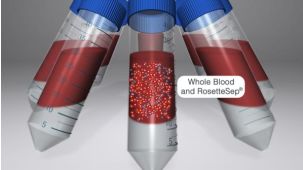
The antibody cocktail crosslinks unwanted cells to red blood cells (RBCs), forming rosettes. The unwanted cells then pellet with the free RBCs when centrifuged over a density centrifugation medium (e.g. Ficoll-Paque™ PLUS, Lymphoprep™).

What factors affect cell recovery?

The temperature of the reagents can affect cell recovery. All reagents should be at room temperature (sample, density centrifugation medium, PBS, centrifuge) before performing the isolations. Layering can also affect recovery so be sure to carefully layer the sample to avoid mixing with the density centrifugation medium as much as possible. Be sure to collect the entire enriched culture without disturbing the RBC pellet. A small amount of density centrifugation medium can be collected without worry.

Which cell samples can RosetteSep™ be used with?

RosetteSep™ can be used with leukapheresis samples, bone marrow or buffy coat, as long as: the concentration of cells does not exceed 5 x 10⁷ per mL (can dilute if necessary); and there are at least 100 RBCs for every nucleated cell (RBCs can be added if necessary).

Can RosetteSep™ be used with previously frozen or cultured cells?

Yes. Cells should be re-suspended at 2 - 5 x 10⁷ cells / mL in PBS + 2% FBS. Fresh whole blood should be added at 250 µL per mL of sample, as a source of red cells.

Can RosetteSep™ be used to enrich progenitors from cord blood?

Yes. Sometimes cord blood contains immature nucleated red cells that have a lower density than mature RBCs. These immature red cells do not pellet over Ficoll™, which can lead to a higher RBC contamination than peripheral blood separations.

Does RosetteSep™ work with mouse cells?

No, but we have developed EasySep™, a magnetic-based cell isolation system which works with mouse and other non-human species.

Which anticoagulant should be used with RosetteSep™?

Peripheral blood should be collected in heparinized Vacutainers. Cord blood should be collected in ACD.

Should the anticoagulant be washed off before using RosetteSep™?

No, the antibody cocktail can be added directly to the sample.

文献 (8)

Transfusion medicine illustrated. The mesenchymal stem cell revealed. Merino A et al. Transfusion 2003 JAN
Isolation of multipotent mesenchymal stem cells from umbilical cord blood. Lee OK et al. Blood 2004 MAR

Abstract

It is well accepted that umbilical cord blood has been a source for hematopoietic stem cells. However,controversy exists as to whether cord blood can serve as a source of mesenchymal stem cells,which can differentiate into cells of different connective tissue lineages such as bone,cartilage,and fat,and little success has been reported in the literature about the isolation of such cells from cord blood. Here we report a novel method to obtain single cell-derived,clonally expanded mesenchymal stem cells that are of multilineage differentiation potential by negative immunoselection and limiting dilution. The immunophenotype of these clonally expanded cells is consistent with that reported for bone marrow mesenchymal stem cells. Under appropriate induction conditions,these cells can differentiate into bone,cartilage,and fat. Surprisingly,these cells were also able to differentiate into neuroglial- and hepatocyte-like cells under appropriate induction conditions and,thus,these cells may be more than mesenchymal stem cells as evidenced by their ability to differentiate into cell types of all 3 germ layers. In conclusion,umbilical cord blood does contain mesenchymal stem cells and should not be regarded as medical waste. It can serve as an alternative source of mesenchymal stem cells to bone marrow.
Contribution of human bone marrow stem cells to individual skeletal myotubes followed by myogenic gene activation. Lee J-H et al. Experimental cell research 2005 JUL

Abstract

Much attention is focused on characterizing the contribution of bone marrow (BM)-derived cells to regenerating skeletal muscle,fuelled by hopes for stem cell-mediated therapy of muscle degenerative diseases. Though physical integration of BM stem cells has been well documented,little evidence of functional commitment to myotube phenotype has been reported. This is due to the innate difficulty in distinguishing gene products derived from donor versus host nuclei. Here,we demonstrate that BM-derived stem cells contribute via gene expression following incorporation to skeletal myotubes. By co-culturing human BM-derived mesenchymal stem cells (MSC) with mouse skeletal myoblasts,physical incorporation was observed by genetic lineage tracing and species-specific immunofluorescence. We used a human-specific antibody against the intermediate filament protein nestin,a marker of regenerating skeletal muscle,to identify functional contribution of MSC to myotube formation. Although nestin expression was never detected in MSC,human-specific expression was detected in myotubes that also contained MSC-derived nuclei. This induction of gene expression following myotube integration suggests that bone marrow-derived stem cells can reprogram and functionally contribute to the muscle cell phenotype. We propose that this model of myogenic commitment may provide the means to further characterize functional reprogramming of MSC to skeletal muscle.

更多信息

更多信息
物种
样本来源 骨髓
Selection Method Negative
质量保证:

产品仅供研究使用,不用于针对人或动物的诊断或治疗。 欲获悉更多关于STEMCELL的质控信息,请访问 STEMCELL.CN/COMPLIANCE.
Copyright © 2026 by STEMCELL Technologies. All rights reserved.

在线联系