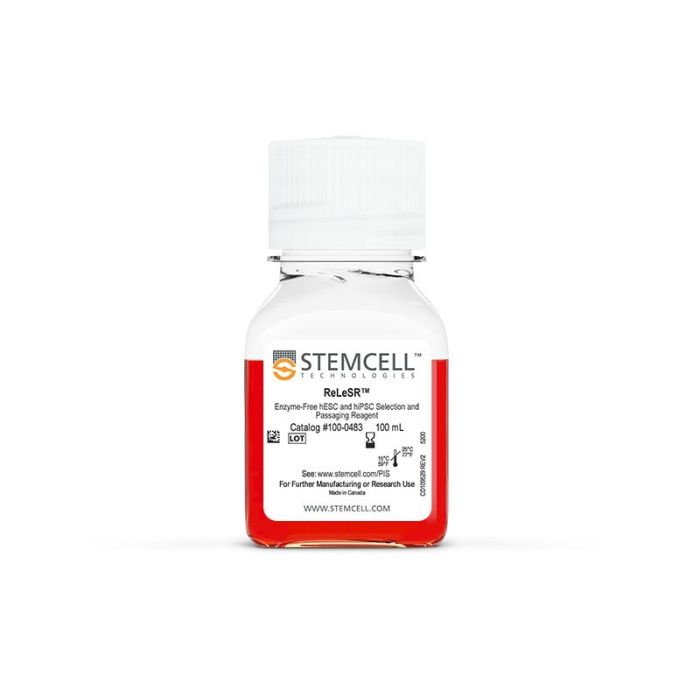
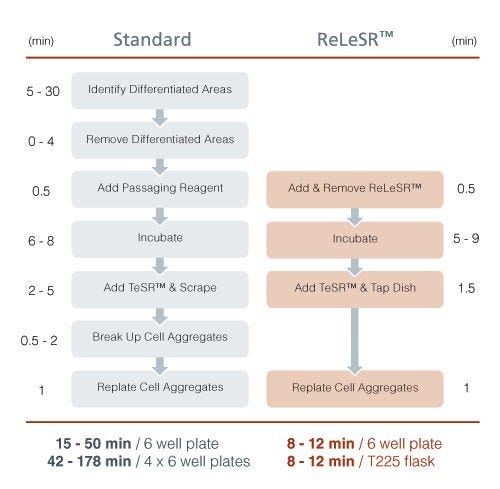
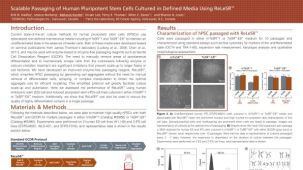
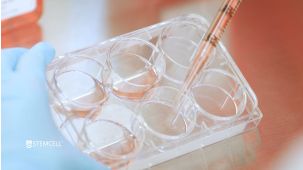
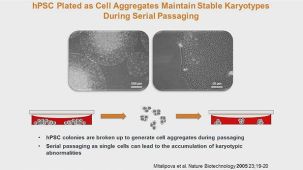
ReLeSR™ passaging protocol eliminates difficult and time-consuming steps, thereby enabling easy culture scale-up. Surface area of 4 x 6 well plates (230 cm²) is comparable to that of a T225 flask (225 cm²). TeSR™ = TeSR™ family media (mTeSR™1, TeSR™2, or TeSR™-E8™).
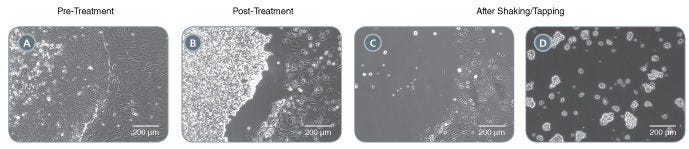
ReLeSR™ selectively detaches undifferentiated cells from pluripotent stem cell cultures without manual selection. Optimally-sized aggregates are generated following shaking/tapping of the cultureware. (A) An hPSC culture ready for passaging. Note the presence of differentiated cells at the edge of the undifferentiated hPSC colony. (B) Following incubation with ReLeSR™, the undifferentiated hPSC colony starts to lift off of the cultureware. The differentiated cells remain attached to the cultureware. (C) Following shaking/tapping of the cultureware, the undifferentiated cells completely lift off of the cultureware. (D) The undifferentiated hPSC colony is broken up into optimally-sized aggregates for replating.
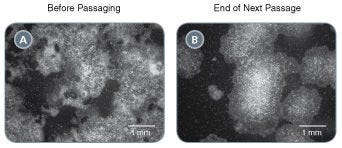
Figure 3. Rescue Highly Differentiated Cultures
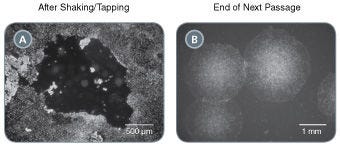
Poor quality human pluripotent stem cell cultures containing large proportions of differentiated cells can be rescued by passaging with ReLeSR™. (A) A poor quality hPSC culture containing ~50% undifferentiated cells. (B) Following passaging with ReLeSR™, the differentiated cells have largely been eliminated from the culture, with >90% undifferentiated cells present at the end of the next passage.
Figure 4. Select Putative iPS Cell Clones
Easily isolate newly generated human iPS cell colonies with ReLeSR™ by selectively detaching undifferentiated cells and leaving non reprogrammed cells behind. (A) A TeSR™-E7™ reprogramming culture which has been treated with ReLeSR™ to detach the putative iPS cell colony, leaving the non-reprogrammed and differentiated cells behind. (B) Cultures contain a high proportion of undifferentiated cells by the end of the first passage.
A Concise Protocol for siRNA-Mediated Gene Suppression in Human Embryonic Stem Cells. Renz PF and Beyer TA
Methods in molecular biology (Clifton,N.J.) 2016 FEB
Abstract
Human embryonic stem cells hold great promise for future biomedical applications such as disease modeling and regenerative medicine. However,these cells are notoriously difficult to culture and are refractory to common means of genetic manipulation,thereby limiting their range of applications. In this protocol,we present an easy and robust method of gene repression in human embryonic stem cells using lipofection of small interfering RNA (siRNA).
Cell-fate determination by ubiquitin-dependent regulation of translation Werner A et al.
Nature 2015 SEP
Abstract
Metazoan development depends on the accurate execution of differentiation programs that allow pluripotent stem cells to adopt specific fates. Differentiation requires changes to chromatin architecture and transcriptional networks,yet whether other regulatory events support cell-fate determination is less well understood. Here we identify the ubiquitin ligase CUL3 in complex with its vertebrate-specific substrate adaptor KBTBD8 (CUL3(KBTBD8)) as an essential regulator of human and Xenopus tropicalis neural crest specification. CUL3(KBTBD8) monoubiquitylates NOLC1 and its paralogue TCOF1,the mutation of which underlies the neurocristopathy Treacher Collins syndrome. Ubiquitylation drives formation of a TCOF1-NOLC1 platform that connects RNA polymerase I with ribosome modification enzymes and remodels the translational program of differentiating cells in favour of neural crest specification. We conclude that ubiquitin-dependent regulation of translation is an important feature of cell-fate determination.
Defined three-dimensional microenvironments boost induction of pluripotency Caiazzo M et al.
Nature Materials 2016 MAR
Abstract
Since the discovery of induced pluripotent stem cells (iPSCs),numerous approaches have been explored to improve the original protocol,which is based on a two-dimensional (2D) cell-culture system. Surprisingly,nothing is known about the effect of a more biologically faithful 3D environment on somatic-cell reprogramming. Here,we report a systematic analysis of how reprogramming of somatic cells occurs within engineered 3D extracellular matrices. By modulating microenvironmental stiffness,degradability and biochemical composition,we have identified a previously unknown role for biophysical effectors in the promotion of iPSC generation. We find that the physical cell confinement imposed by the 3D microenvironment boosts reprogramming through an accelerated mesenchymal-to-epithelial transition and increased epigenetic remodelling. We conclude that 3D microenvironmental signals act synergistically with reprogramming transcription factors to increase somatic plasticity.
Thank you for your interest in IntestiCult™ Organoid Growth Medium (Human). Please provide us with your contact information and your local representative will contact you with a customized quote. Where appropriate, they
can also assist you with a(n):
Estimated delivery time for your area
Product sample or exclusive offer
In-lab demonstration
By submitting this form, you are providing your consent to STEMCELL Technologies Canada Inc. and its subsidiaries and affiliates (“STEMCELL”) to collect and use your information, and send you newsletters and emails in accordance with our
privacy policy. Please contact us with any questions that you may have. You can unsubscribe or change your email preferences at any time.
THIS PRODUCT IS MANUFACTURED AND TESTED FOLLOWING RELEVANT CGMPs UNDER A CERTIFIED QUALITY MANAGEMENT SYSTEM. PRODUCT IS FOR FURTHER MANUFACTURING OR RESEARCH USE. NOT INTENDED FOR HUMAN OR ANIMAL DIAGNOSTIC OR THERAPEUTIC USES UNLESS OTHERWISE STATED. 欲获悉更多关于STEMCELL的质控信息,请访问 WWW.STEMCELL.COM/COMPLIANCE