若您需要咨询产品或有任何技术问题,请通过官方电话 400 885 9050 或邮箱 info.cn@stemcell.com 与我们联系。

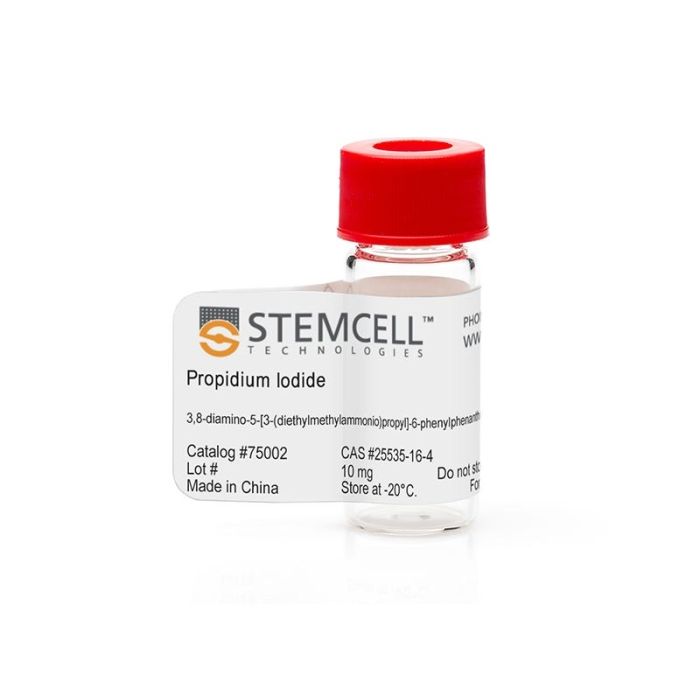
碘化丙啶

细胞活力染料(DNA标记染料)
只有 %1 左
¥1,152.00

产品号 #(选择产品)

产品号 #75002_C

细胞活力染料(DNA标记染料)

总览

碘化丙啶(PI)是一种红色荧光细胞活性染料,可被细胞膜完整的活细胞排除,但能穿透死亡或受损细胞的细胞膜,并通过嵌插方式结合于DNA和RNA碱基之间。PI 广泛应用于流式细胞术中,作为复染剂用于区分并排除非活细胞。其可被蓝光(488 nm)、绿光(532 nm)或黄绿光(561 nm)激发,并通过 FL2 或 FL3 通道进行检测。此外,PI 也用于 DNA 荧光成像,以识别细胞凋亡的早期和晚期阶段、研究细胞介导的细胞毒性作用,以及进行染色体分析。它亦常用于 DNA 定量分析实验中。

别名
3,8-二氨基-5-{3-[二乙基(甲基)氨基]丙基}-6-苯基苯并吡啶铵二碘化物;PI;碘化丙啶
 
细胞类型
其他物种
 
种属
人,小鼠,非人灵长类,其他物种,大鼠
 
应用
流式细胞术
 
研究领域
免疫,神经科学,干细胞生物学
 
CAS 编号
25535-16-4
 
化学式
C₂₇H₃₄N₄ · 2I
 
分子量
668.4 g/mol
 

实验数据

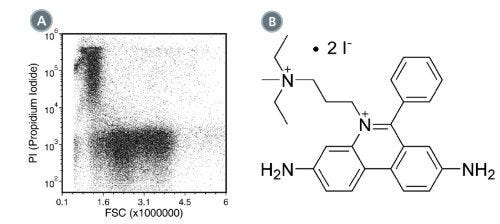
(A) Flow cytometry analysis of human peripheral blood mononuclear cells (PBMCs) labeled with Propidium Iodide

Figure 1. (A) Flow cytometry analysis of human peripheral blood mononuclear cells (PBMCs) labeled with Propidium Iodide

(B) Chemical structure of Propidium Iodide.

产品说明书及文档

请在《产品说明书》中查找相关支持信息和使用说明,或浏览下方更多实验方案。

Document Type
Product Name
Catalog #
Lot #
Language
Product Name
Propidium Iodide
Catalog #
75002
Lot #
All
Language
English
Document Type
Safety Data Sheet
Product Name
Propidium Iodide
Catalog #
75002
Lot #
All
Language
English

应用领域

本产品专为以下研究领域设计,适用于工作流程中的高亮阶段。探索这些工作流程,了解更多我们为各研究领域提供的其他配套产品。

相关材料与文献

技术资料 (1)

文献 (2)

Incorporation of decellularized-ECM in graphene-based scaffolds enhances axonal outgrowth and branching in neuro-muscular co-cultures Science Progress 2024 Sep

Abstract

Peripheral nerve and large-scale muscle injuries result in significant disability,necessitating the development of biomaterials that can restore functional deficits by promoting tissue regrowth in an electroactive environment. Among these materials,graphene is favored for its high conductivity,but its low bioactivity requires enhancement through biomimetic components. In this study,we extrusion printed graphene-poly(lactide-co-glycolide) (graphene) lattice scaffolds,aiming to increase bioactivity by incorporating decellularized extracellular matrix (dECM) derived from mouse pup skeletal muscle. We first evaluated these scaffolds using human-induced pluripotent stem cell (hiPSC)-derived motor neurons co-cultured with supportive glia,observing significant improvements in axon outgrowth. Next,we tested the scaffolds with C2C12 mouse and human primary myoblasts,finding no significant differences in myotube formation between dECM-graphene and graphene scaffolds. Finally,using a more complex hiPSC-derived 3D motor neuron spheroid model co-cultured with human myoblasts,we demonstrated that dECM-graphene scaffolds significantly improved axonal expansion towards peripheral myoblasts and increased axonal network density compared to graphene-only scaffolds. Features of early neuromuscular junction formation were identified near neuromuscular interfaces in both scaffold types. These findings suggest that dECM-graphene scaffolds are promising candidates for enhancing neuromuscular regeneration,offering robust support for the growth and development of diverse neuromuscular tissues.
A Deficiency in Glutamine-Fructose-6-Phosphate Transaminase 1 (Gfpt1) in Skeletal Muscle Results in Reduced Glycosylation of the Delta Subunit of the Nicotinic Acetylcholine Receptor (AChRδ) S. Holland et al. Biomolecules 2024 Oct

Abstract

The neuromuscular junction (NMJ) is the site where the motor neuron innervates skeletal muscle,enabling muscular contraction. Congenital myasthenic syndromes (CMS) arise when mutations in any of the approximately 35 known causative genes cause impaired neuromuscular transmission at the NMJ,resulting in fatigable muscle weakness. A subset of five of these CMS-causative genes are associated with protein glycosylation. Glutamine-fructose-6-phosphate transaminase 1 (Gfpt1) is the rate-limiting enzyme within the hexosamine biosynthetic pathway (HBP),a metabolic pathway that produces the precursors for glycosylation. We hypothesized that deficiency in Gfpt1 expression results in aberrant or reduced glycosylation,impairing the proper assembly and stability of key NMJ-associated proteins. Using both in vitro and in vivo Gfpt1-deficient models,we determined that the acetylcholine receptor delta subunit (AChRδ) has reduced expression and is hypo-glycosylated. Using laser capture microdissection,NMJs were harvested from Gfpt1 knockout mouse muscle. A lower-molecular-weight species of AChRδ was identified at the NMJ that was not detected in controls. Furthermore,Gfpt1-deficient muscle lysates showed impairment in protein O-GlcNAcylation and sialylation,suggesting that multiple glycan chains are impacted. Other key NMJ-associated proteins,in addition to AChRδ,may also be differentially glycosylated in Gfpt1-deficient muscle.

更多信息

更多信息
Molecular Weight 668.4 g/mol
物种 人, 其它物种, 大鼠, 小鼠, 非人灵长类
Alternative Names 3, 8-Diamino-5-{3-[diethyl(methyl)ammonio]propyl}-6-phenylphenanthridinium diiodide; PI; Propidium diiodide
Cas Number 25535-16-4
Chemical Formula C₂₇H₃₄N₄ · 2I
质量保证:

产品仅供研究使用,不用于针对人或动物的诊断或治疗。
Copyright © 2026 by STEMCELL Technologies. All rights reserved.

在线联系