若您需要咨询产品或有任何技术问题,请通过官方电话 400 885 9050 或邮箱 info.cn@stemcell.com 与我们联系。

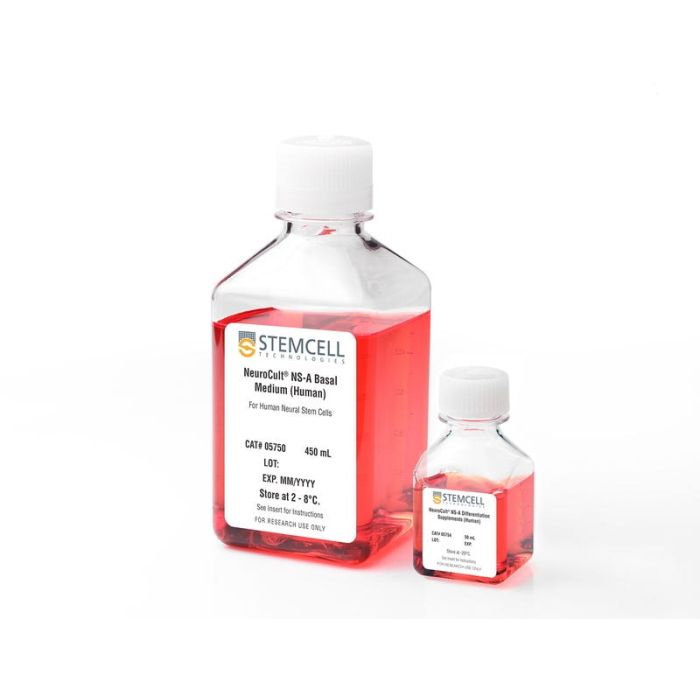
NeuroCult™ NS-A 分化试剂盒(人)

人神经干细胞和祖细胞分化的培养基
只有 %1
¥3,514.00

产品号 #(选择产品)

产品号 #05752_C

人神经干细胞和祖细胞分化的培养基

产品组分包括

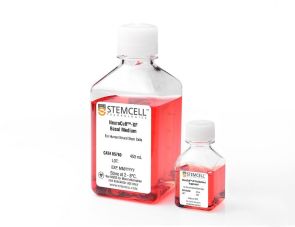
  • NeuroCult™NS-A基础培养基(人),450 mL(产品号#05750)
  • NeuroCult™ 分化添加物(人),50mL

总览

NeuroCult™NS-A分化试剂盒(人)是一种标准化培养基,用于将人神经干和祖细胞分化为神经元、星形胶质细胞和少突胶质细胞。

包含
• 血清
 
分类
专用培养基
 
细胞类型
脑肿瘤干细胞,神经干/祖细胞
 
种属

 
应用
细胞培养,分化,功能学筛选
 
品牌
NeuroCult
 
研究领域
癌症,药物发现和毒理检测,神经科学,干细胞生物学
 

实验数据

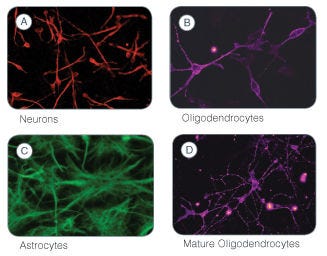
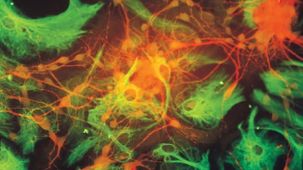
Immunofluorescent staining to identify the differentiated cell types generated following culture of neural stem and progenitor cells in NeuroCult™ NS-A Differentiation Medium

Figure 1. Immunofluorescent Labeling to Identify the Differentiated Cell Types Generated Following Culture of Human Neural Stem and Progenitor Cells in the NeuroCult™ NS-A Differentiation Kit (Human)

A) Neurons (red) were detected with a mouse monoclonal ß-Tubulin III antibody. B) Immature oligodendrocytes (purple) were detected with a rabbit monoclonal O4 Oligodendrocyte Marker antibody. C) Astrocytes (green) were detected with a rabbit polyclonal GFAP antibody. D) Mature oligodendrocytes (purple) were detected with a galactocerebroside antibody.

产品说明书及文档

请在《产品说明书》中查找相关支持信息和使用说明,或浏览下方更多实验方案。

Document Type
Product Name
Catalog #
Lot #
Language
Catalog #
05752
Lot #
All
Language
English
Document Type
Technical Manual
Catalog #
05752
Lot #
All
Language
English
Document Type
Safety Data Sheet 1
Catalog #
05752
Lot #
All
Language
English
Document Type
Safety Data Sheet 2
Catalog #
05752
Lot #
All
Language
English

应用领域

本产品专为以下研究领域设计,适用于工作流程中的高亮阶段。探索这些工作流程,了解更多我们为各研究领域提供的其他配套产品。

相关材料与文献

技术资料 (10)

文献 (14)

Endothelial cells create a stem cell niche in glioblastoma by providing NOTCH ligands that nurture self-renewal of cancer stem-like cells. Zhu TS et al. Cancer research 2011 SEP

Abstract

One important function of endothelial cells in glioblastoma multiforme (GBM) is to create a niche that helps promote self-renewal of cancer stem-like cells (CSLC). However,the underlying molecular mechanism for this endothelial function is not known. Since activation of NOTCH signaling has been found to be required for propagation of GBM CSLCs,we hypothesized that the GBM endothelium may provide the source of NOTCH ligands. Here,we report a corroboration of this concept with a demonstration that NOTCH ligands are expressed in endothelial cells adjacent to NESTIN and NOTCH receptor-positive cancer cells in primary GBMs. Coculturing human brain microvascular endothelial cells (hBMEC) or NOTCH ligand with GBM neurospheres promoted GBM cell growth and increased CSLC self-renewal. Notably,RNAi-mediated knockdown of NOTCH ligands in hBMECs abrogated their ability to induce CSLC self-renewal and GBM tumor growth,both in vitro and in vivo. Thus,our findings establish that NOTCH activation in GBM CSLCs is driven by juxtacrine signaling between tumor cells and their surrounding endothelial cells in the tumor microenvironment,suggesting that targeting both CSLCs and their niche may provide a novel strategy to deplete CSLCs and improve GBM treatment.
Isolation and expansion of human glioblastoma multiforme tumor cells using the neurosphere assay. Azari H et al. Journal of visualized experiments : JoVE 2011 JAN

Abstract

Stem-like cells have been isolated in tumors such as breast,lung,colon,prostate and brain. A critical issue in all these tumors,especially in glioblastoma mutliforme (GBM),is to identify and isolate tumor initiating cell population(s) to investigate their role in tumor formation,progression,and recurrence. Understanding tumor initiating cell populations will provide clues to finding effective therapeutic approaches for these tumors. The neurosphere assay (NSA) due to its simplicity and reproducibility has been used as the method of choice for isolation and propagation of many of this tumor cells. This protocol demonstrates the neurosphere culture method to isolate and expand stem-like cells in surgically resected human GBM tumor tissue. The procedures include an initial chemical digestion and mechanical dissociation of tumor tissue,and subsequently plating the resulting single cell suspension in NSA culture. After 7-10 days,primary neurospheres of 150-200 μm in diameter can be observed and are ready for further passaging and expansion.
A distinct subpopulation within CD133 positive brain tumor cells shares characteristics with endothelial progenitor cells Choi SA et al. Cancer Letters 2012 NOV

Abstract

The cell surface marker CD133 has been proposed as a brain tumor stem cell marker. However,there have been substantial controversies regarding the necessity and role of CD133 in tumorigenesis. This study aimed to characterize CD133(+) cells in brain tumors. Human brain tumor specimens and whole blood were collected from the same patients (N=12). We carried out dual FACS staining for CD133/CD34 and functional tumorigenesis and angiogenesis analyses of CD133(+) cells from different origins. We also investigated the in vivo tumorigenic potential and histological characteristics of four distinct groups on the basis of expression of CD133/CD34 markers (CD133(+),CD133(+)/CD34(+),CD133(+)/CD34(-),and CD133(-)). CD133(+) brain tumor cells coexpressed significantly higher positivity for CD34 (70.7±5.2% in CD133(+) vs. 12.3±4.2% in CD133(-) cells,P<0.001). CD133(+) brain tumor cells formed neurosphere-like spheroids and differentiated into multiple nervous system lineages unlike CD133(+) blood cells. They showed biological characteristics of endothelial cells,including vWF expression,LDL uptake and tube formation in vitro,unlike CD133(-) brain tumors cells. Pathologic analysis of brains implanted with CD133(+) cells showed large,markedly hypervascular tumors with well-demarcated boundary. CD133(+)/CD34(-) cells produced smaller but highly infiltrative tumors. Notably,pure angiogenic cell fractions (CD133(+)/CD34(+)) and CD133(-) tumor cells did not generate tumors in vivo. Our data suggest the presence of a distinct subpopulation of CD133(+) cells isolated from human brain tumors,with characteristics of endothelial progenitor cells (EPCs).

更多信息

更多信息
物种
Contains • Serum
法律声明:

Sold under license from StemCells California, Inc. US Patent Nos. 5,750,376; 5,851,832; 5,980,885; 5,968,829; 5,981,165; 6,071,889; 6,093,531; 6,103,530; 6,165,783; 6,238,922. 质量保证:

产品仅供研究使用,不用于针对人或动物的诊断或治疗。 欲获悉更多关于STEMCELL的质控信息,请访问 STEMCELL.CN/COMPLIANCE.
Copyright © 2026 by STEMCELL Technologies. All rights reserved.

在线联系