若您需要咨询产品或有任何技术问题,请通过官方电话 400 885 9050 或邮箱 info.cn@stemcell.com 与我们联系。

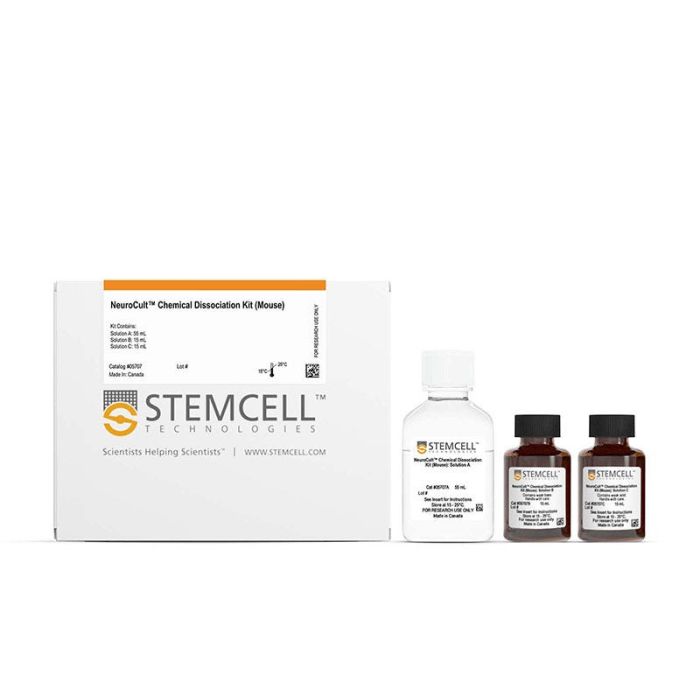
NeuroCult™化学解离试剂盒(小鼠)

小鼠神经球化学解离试剂盒
只有 %1
¥2,018.00

产品号 #(选择产品)

产品号 #05707_C

小鼠神经球化学解离试剂盒

产品优势

  • 通过非机械和非酶解的细胞解离法获得干净的细胞培养物
  • 与研磨法相比,扩增后的细胞活率和总细胞数显著提高
  • 确保最小的细胞损伤并维持细胞的功能性

产品组分包括

  • NeuroCult™化学解离试剂A, 55 mL
  • NeuroCult™化学解离试剂B, 15 mL
  • NeuroCult™化学解离试剂C, 15 mL

总览

使用NeuroCult™化学解离试剂盒解离源于胚胎或成年小鼠中枢神经系统组织的神经球。相比研磨法,这种温和、非机械和非酶解的解离法可最大程度地减小对细胞的损伤,且在扩增后可确保更高的细胞活率和总细胞数。使用NeuroCult™化学分离试剂盒解离的细胞在后续传代培养中也能保持其功能特性。

分类
非酶法
 
细胞类型
神经干/祖细胞
 
种属
小鼠
 
应用
细胞培养
 
品牌
NeuroCult
 
研究领域
药物发现和毒性检测,神经科学,干细胞生物学
 

实验数据

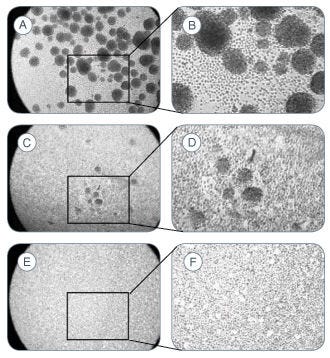
Chemical Dissociation of Mouse Neurospheres

Figure 1. Chemical Dissociation of Mouse Neurospheres

Photomicrographs showing the chemical dissociation of mouse neurospheres at (A) 2 minutes (C) 5 minutes and (E) 7 minutes after the addition of NeuroCult™ Chemical Dissociation Solution B. Figures (B), (D) and (F) are enlargements of the boxed areas in figures (A), (C) and (E), respectively. A single cell suspension is evident in (E) and (F).

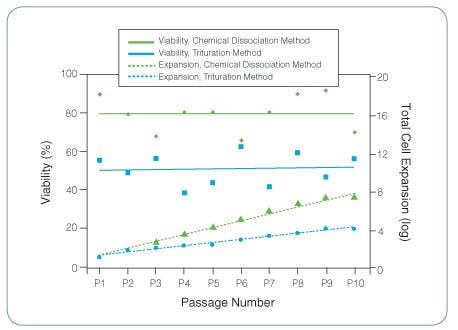
Comparison of Percent Viability and Cell Expansion Between the Neurocult™ Chemical Dissociation Kit and Trituration

Figure 2. Comparison of Percent Viability and Cell Expansion Between the Neurocult™ Chemical Dissociation Kit and Trituration

Mouse neurospheres were dissociated at each passage (up to P10) with the NeuroCult™ Chemical Dissociation Kit or trituration. Cells dissociated with the NeuroCult™ Chemical Dissociation Kit had a significantly higher percent viability and total cell number (after expansion) in comparison with trituration.

产品说明书及文档

请在《产品说明书》中查找相关支持信息和使用说明,或浏览下方更多实验方案。

Document Type
Product Name
Catalog #
Lot #
Language
Catalog #
05707
Lot #
All
Language
English
Document Type
Technical Manual
Catalog #
05707
Lot #
All
Language
English
Document Type
Safety Data Sheet 1
Catalog #
05707
Lot #
All
Language
English
Document Type
Safety Data Sheet 2
Catalog #
05707
Lot #
All
Language
English
Document Type
Safety Data Sheet 3
Catalog #
05707
Lot #
All
Language
English

应用领域

本产品专为以下研究领域设计,适用于工作流程中的高亮阶段。探索这些工作流程,了解更多我们为各研究领域提供的其他配套产品。

相关材料与文献

技术资料 (7)

文献 (35)

Unique dielectric properties distinguish stem cells and their differentiated progeny. Flanagan LA et al. Stem cells (Dayton,Ohio) 2008 MAR

Abstract

The relatively new field of stem cell biology is hampered by a lack of sufficient means to accurately determine the phenotype of cells. Cell-type-specific markers,such as cell surface proteins used for flow cytometry or fluorescence-activated cell sorting,are limited and often recognize multiple members of a stem cell lineage. We sought to develop a complementary approach that would be less dependent on the identification of particular markers for the subpopulations of cells and would instead measure their overall character. We tested whether a microfluidic system using dielectrophoresis (DEP),which induces a frequency-dependent dipole in cells,would be useful for characterizing stem cells and their differentiated progeny. We found that populations of mouse neural stem/precursor cells (NSPCs),differentiated neurons,and differentiated astrocytes had different dielectric properties revealed by DEP. By isolating NSPCs from developmental ages at which they are more likely to generate neurons,or astrocytes,we were able to show that a shift in dielectric property reflecting their fate bias precedes detectable marker expression in these cells and identifies specific progenitor populations. In addition,experimental data and mathematical modeling suggest that DEP curve parameters can indicate cell heterogeneity in mixed cultures. These findings provide evidence for a whole cell property that reflects stem cell fate bias and establish DEP as a tool with unique capabilities for interrogating,characterizing,and sorting stem cells.
Myc increases self-renewal in neural progenitor cells through Miz-1. Kerosuo L et al. Journal of cell science 2008 DEC

Abstract

The mechanisms underlying the decision of a stem or progenitor cell to either self-renew or differentiate are incompletely understood. To address the role of Myc in this process,we expressed different forms of the proto-oncogene Myc in multipotent neural progenitor cells (NPCs) using retroviral transduction. Expression of Myc in neurospheres increased the proportion of self-renewing cells fivefold,and 1% of the Myc-overexpressing cells,but none of the control cells,retained self-renewal capacity even under differentiation-inducing conditions. A Myc mutant (MycV394D) deficient in binding to Miz-1,did not increase the percentage of self-renewing cells but was able to stimulate proliferation of NPCs as efficiently as wild-type Myc,indicating that these two cellular phenomena are regulated by at least partially different pathways. Our results suggest that Myc,through Miz-1,enhances self-renewal of NPCs and influences the way progenitor cells react to the environmental cues that normally dictate the cellular identity of tissues containing self-renewing cells.
Toll-like receptor 3 is a negative regulator of embryonic neural progenitor cell proliferation. Lathia JD et al. The Journal of neuroscience : the official journal of the Society for Neuroscience 2008 DEC

Abstract

Toll-like receptors (TLRs) play important roles in innate immunity. Several TLR family members have recently been shown to be expressed by neurons and glial cells in the adult brain,and may mediate responses of these cells to injury and infection. To address the possibility that TLRs play a functional role in development of the nervous system,we analyzed the expression of TLRs during different stages of mouse brain development and assessed the role of TLRs in cell proliferation. TLR3 protein is present in brain cells in early embryonic stages of development,and in cultured neural stem/progenitor cells (NPC). NPC from TLR3-deficient embryos formed greater numbers of neurospheres compared with neurospheres from wild-type embryos. Numbers of proliferating cells,as assessed by phospho histone H3 and proliferating cell nuclear antigen labeling,were also increased in the developing cortex of TLR3-deficient mice compared with wild-type mice in vivo. Treatment of cultured embryonic cortical neurospheres with a TLR3 ligand (polyIC) significantly reduced proliferating (BrdU-labeled) cells and neurosphere formation in wild type but not TLR3(-/-)-derived NPCs. Our findings reveal a novel role for TLR3 in the negative regulation of NPC proliferation in the developing brain.

更多信息

更多信息
物种 小鼠
质量保证:

产品仅供研究使用,不用于针对人或动物的诊断或治疗。 欲获悉更多关于STEMCELL的质控信息,请访问 STEMCELL.CN/COMPLIANCE.
Copyright © 2026 by STEMCELL Technologies. All rights reserved.

在线联系