若您需要咨询产品或有任何技术问题,请通过官方电话 400 885 9050 或邮箱 info.cn@stemcell.com 与我们联系。

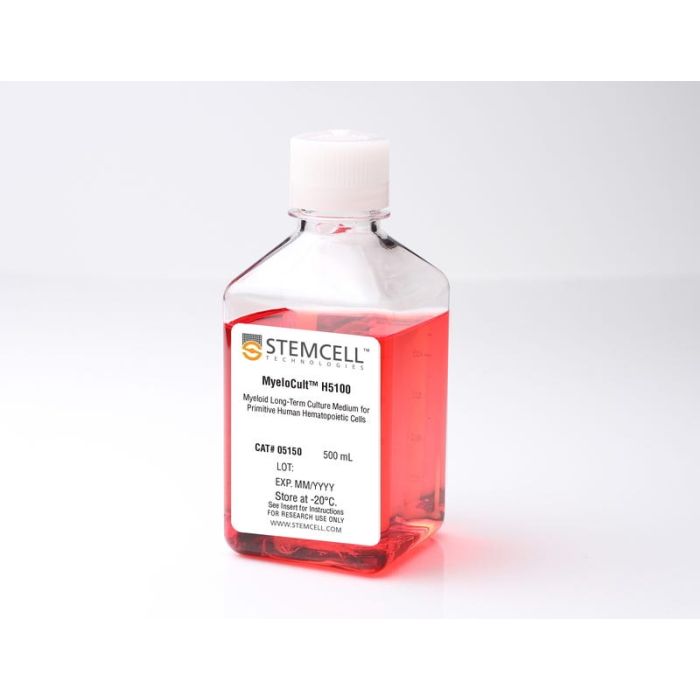
MyeloCult™ H5100

用于长期培养人细胞的培养基
只有 %1
¥5,606.00

产品号 #(选择产品)

产品号 #05100_C

用于长期培养人细胞的培养基

总览

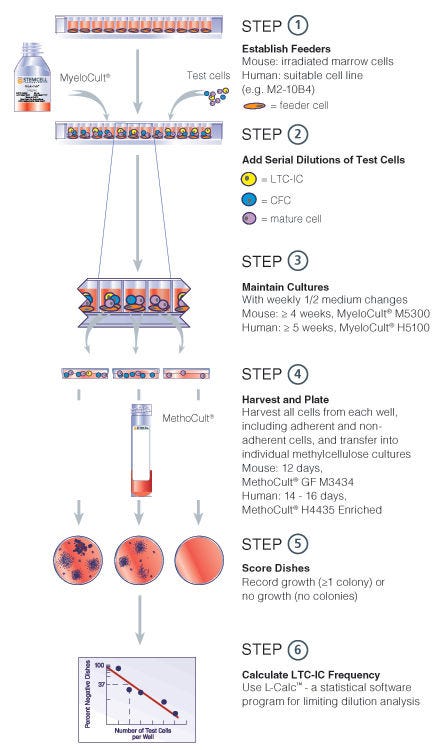
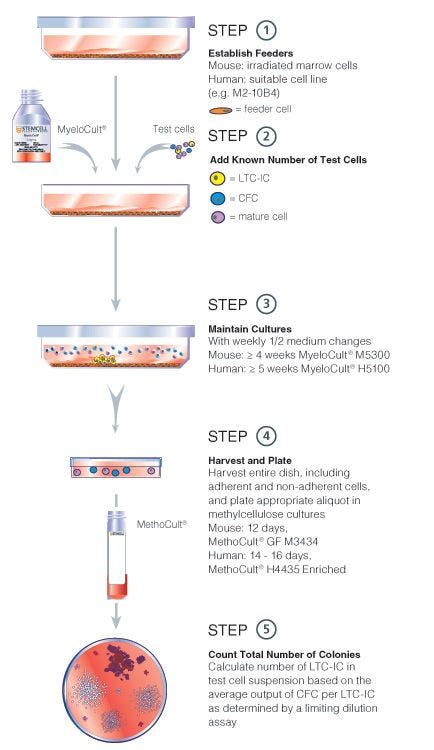
MyeloCult™ H5100是一种用于建立和维持人髓系造血细胞和基质细胞饲养层长期培养的培养基。该培养基中使用的血清已经过预测试并筛选,可支持初始人造血细胞的长期髓系生成(例如长期培养启动细胞(LTC-IC)实验)。MyeloCult™ H5100需要添加新鲜配制的Hydrocortisone(产品号 #74142)。

包含
• 胎牛血清
• 2-巯基乙醇
• 最低必需培养基 (MEM) α
• 添加物
 
分类
专用培养基
 
细胞类型
造血干/祖细胞
 
种属

 
应用
细胞培养,功能学筛选
 
品牌
MyeloCult
 
研究领域
干细胞生物学
 

实验数据

Limiting dilution LTC-IC assay

Figure 1. Limiting dilution LTC-IC assay

Bulk culture LTC-IC assay

Figure 2. Bulk culture LTC-IC assay

产品说明书及文档

请在《产品说明书》中查找相关支持信息和使用说明,或浏览下方更多实验方案。

Document Type
Product Name
Catalog #
Lot #
Language
Catalog #
05150
Lot #
All
Language
English
Document Type
Technical Manual 1
Catalog #
05100
Lot #
All
Language
English
Document Type
Technical Manual 2
Catalog #
05100
Lot #
All
Language
English
Document Type
Safety Data Sheet
Catalog #
05150
Lot #
All
Language
English

应用领域

本产品专为以下研究领域设计,适用于工作流程中的高亮阶段。探索这些工作流程,了解更多我们为各研究领域提供的其他配套产品。

相关材料与文献

技术资料 (5)

文献 (77)

Detection, isolation, and stimulation of quiescent primitive leukemic progenitor cells from patients with acute myeloid leukemia (AML). Guan Y et al. Blood 2003 APR

Abstract

Although many acute myeloid leukemia (AML) colony-forming cells (CFCs) and long-term culture-initiating cells (LTC-ICs) directly isolated from patients are actively cycling,quiescent progenitors are present in most samples. In the current study,(3)H-thymidine ((3)H-Tdr) suicide assays demonstrated that most NOD/SCID mouse leukemia-initiating cells (NOD/SL-ICs) are quiescent in 6 of 7 AML samples. AML cells in G(0),G(1),and S/G(2)+M were isolated from 4 of these samples using Hoechst 33342/pyroninY staining and cell sorting. The progenitor content of each subpopulation was consistent with the (3)H-Tdr suicide results,with NOD/SL-ICs found almost exclusively among G(0) cells while the cycling status of AML CFCs and LTC-ICs was more heterogeneous. Interestingly,after 72 hours in serum-free culture with or without Steel factor (SF),Flt-3 ligand (FL),and interleukin-3 (IL-3),most G(0) AML cells entered active cell cycle (percentage of AML cells remaining in G(0) at 72 hours,1.2% to 37%,and 0% to 7.6% in cultures without and with growth factors [GFs],respectively) while G(0) cells from normal lineage-depleted bone marrow remained quiescent in the absence of GF. All 4 AML samples showed evidence of autocrine production of 2 or more of SF,FL,IL-3,and granulocyte-macrophage colony-stimulating factor (GM-CSF). In addition,3 of 4 samples contained an internal tandem duplication of the FLT3 gene. In summary,quiescent leukemic cells,including NOD/SL-ICs,are present in most AML patients. Their spontaneous entry into active cell cycle in short-term culture might be explained by the deregulated GF signaling present in many AMLs.
Fetal liver stroma consists of cells in epithelial-to-mesenchymal transition. Chagraoui J et al. Blood 2003 APR

Abstract

Liver becomes the predominant site of hematopoiesis by 11.5 dpc (days after coitus) in the mouse and 15 gestational weeks in humans and stays so until the end of gestation. The reason the liver is the major hematopoietic site during fetal life is not clear. In this work,we tried to define which of the fetal liver microenvironmental cell populations would be associated with the development of hematopoiesis and found that a population of cells with mixed endodermal and mesodermal features corresponded to hematopoietic-supportive fetal liver stroma. Stromal cells generated from primary cultures or stromal lines from mouse or human fetal liver in the hematopoietic florid phase expressed both mesenchymal markers (vimentin,osteopontin,collagen I,alpha smooth muscle actin,thrombospondin-1,EDa fibronectin,calponin,Stro-1 antigens,myocyte-enhancer factor 2C) and epithelial (alpha-fetoprotein,cytokeratins 8 and 18,albumin,E-cadherin,hepatocyte nuclear factor 3 alpha) markers. Such a cell population fits with the description of cells in epithelial-to-mesenchymal transition (EMT),often observed during development,including that of the liver. The hematopoietic supportive capacity of EMT cells was lost after hepatocytic maturation,induced by oncostatin M in the cell line AFT024. EMT cells were observed in the fetal liver microenvironment during the hematopoietic phase but not in nonhematopoietic liver by the end of gestation and in the adult. EMT cells represent a novel stromal cell type that may be generated from hepatic endodermal or mesenchymal stem cells or even from circulating hematopoietic stem cells (HSCs) seeding the liver rudiment.
A novel myeloid-like NK cell progenitor in human umbilical cord blood. Perez SA et al. Blood 2003 MAY

Abstract

Natural killer (NK) cell differentiation from pluripotent CD34(+) human hematopoietic stem cells or oligopotent lymphoid progenitors has already been reported. In the present study,long-term cultures of the CD56(-)/CD34(-) myeloid-like adherent cell fraction (ACF) from umbilical cord blood (UCB),characterized by the expression of CD14(+) as well as other myeloid markers,were set up with flt3 ligand (FL) and interleukin-15 (IL-15). The UCB/ACF gradually expressed the CD56 marker,which reached fairly high levels (approximately 90% of the cells were CD56(+)) by day 15. FL plus IL-15-driven ACF/CD56(+) cells progressively expressed a mature NK functional program lysing both NK- and lymphokine-activate killer (LAK)-sensitive tumor targets and producing high levels of interferon-gamma (IFN-gamma),granulocyte-macrophage colony-stimulating factor,tumor necrosis factor alpha,and IL-10 upon stimulation with IL-12 and IL-18. Similar results were obtained when highly purified CD14(+) cells from UCB were cultured with FL and IL-15. In contrast,UCB/CD34(+) cells cultured under the same conditions showed a delayed expression of CD56 and behaved functionally differently in that they exhibited NK but not LAK cytotoxicity and produced significantly fewer cytokines. Kinetic studies on the phenotype of UCB/ACF or UCB/CD14(+) cells cultured in the presence of FL and IL-15 showed a rapid decrease in CD14 expression after day 5,which reached levels of zero by day 20. Approximately 60% of the CD56(+) derived from the UCB/ACF or the UCB/CD14(+) cells coexpressed CD14 by day 5. Taken together,our data support the role of CD14(+) myeloid-like cells within UCB as a novel progenitor for lymphoid NK cells.

更多信息

更多信息
物种
Contains • Fetal bovine serum • 2-Mercaptoethanol • Minimum Essential Medium (MEM) Alpha • Supplements
质量保证:

产品仅供研究使用,不用于针对人或动物的诊断或治疗。 欲获悉更多关于STEMCELL的质控信息,请访问 STEMCELL.CN/COMPLIANCE.
Copyright © 2026 by STEMCELL Technologies. All rights reserved.

在线联系