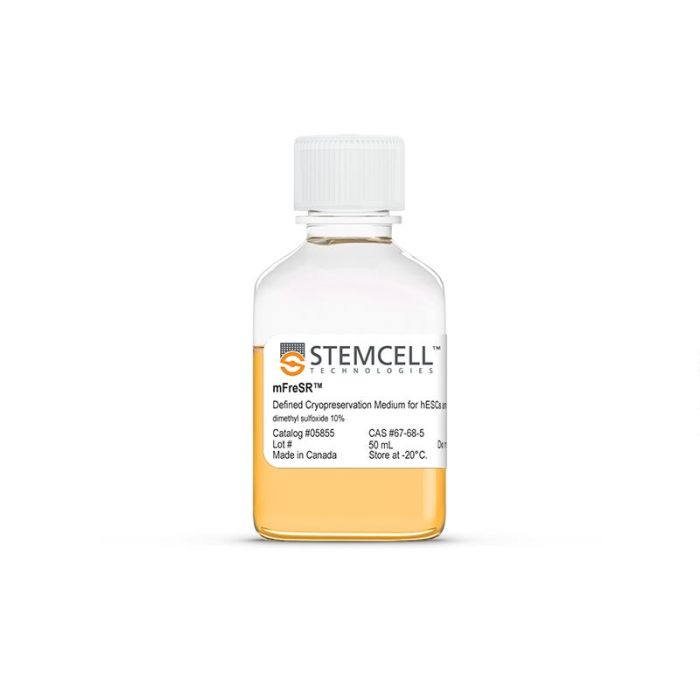
You may notice that your reagent packaging looks slightly different from images displayed here or from previous orders. Due to pandemic-related plasticware shortages, we are temporarily using alternative bottles for this product. Rest assured that the products themselves and how you should use them have not changed.
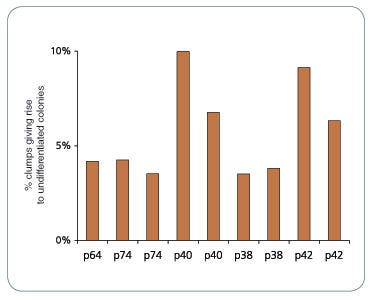
Figure 1. mFreSR™ Improves Thawing Efficiencies 5- to 10-Fold over Other Reported Methods
H9 hESCs were cryopreserved in mFreSR™ at the indicated passage number. Thawing efficiencies were analyzed by counting the number of surviving clumps after thawing.
Human embryonic stem cell lines isolation, cultivation, and characterization Lagarkova MA et al.
In vitro cellular & developmental biology. Animal 2010 APR
Abstract
A large number of human embryonic stem cell (hESC) lines have been derived worldwide since the first hESC line establishment in 1998. Despite many common characteristics,most important of which is the pluripotency,hESC lines vary significantly in their transcriptional profiles,genetic,and epigenetic state. These differences may arise both from individual genetics of the cell lines and from variations in their handling such as isolation and cultivation. In order to minimize the latter differences,the standardized protocols of cultivation and inter-laboratory comprehensive studies should be performed. In this report,we summarized our experience of derivation and characterization of hESC lines as well as of adaptation of hESCs to novel cultivation protocols. We have successfully derived five hESC lines and characterized them by previously established criteria,including expression of specific markers and the capacity to differentiate both in vitro and in vivo. Four of these lines,namely hESM01-04,were initially derived using mouse fibroblasts as a feeder and currently are maintained under feeder-free,serum-free conditions using mTeSR1 and Matrigel. The fifth line,hESMK05 was derived in feeder-free,serum-free conditions using mTeSR1 and Matrigel. Cell lines retain their pluripotent status and normal karyotype for more than 70 passages and are available to the scientific community.
Establishment of hESC lines from the inner cell mass of blastocyst-stage embryos and single blastomeres of 4-cell stage embryos. Mateizel I et al.
Methods in molecular biology (Clifton,N.J.) 2012 JAN
Abstract
More than 600 human embryonic stem cell (hESC) lines have been reported today at the human European Embryonic Stem Cell Registry ( http://www.hescreg.eu/ ). Despite these high numbers,there are currently no general protocols for derivation,culture,and characterization of hESC. Moreover,data on the culture of the embryo used for the derivation (medium,day of ICM isolation) are usually not available but can have an impact on the derivation rate. We present here the protocols for derivation,culture and characterization as we applied them for the 22 hESC lines (named VUB-hESC) in our laboratory.
Generation of human-induced pluripotent stem cells to model spinocerebellar ataxia type 2 in vitro Xia G et al.
Journal of Molecular Neuroscience 2013 OCT
Abstract
Spinocerebellar ataxia type 2 (SCA2) is caused by triple nucleotidebackslashnrepeat (CAG) expansion in the coding region of the ATAXN2 gene onbackslashnchromosome 12,which produces an elongated,toxic polyglutamine tract,backslashnleading to Purkinje cell loss. There is currently no effective therapy.backslashnOne of the main obstacles that hampers therapeutic development is lackbackslashnof an ideal disease model. In this study,we have generated andbackslashncharacterized SCA2-induced pluripotent stem (iPS) cell lines as an inbackslashnvitro cell model. Dermal fibroblasts (FBs) were harvested from primarybackslashncultures of skin explants obtained from a SCA2 subject and a healthybackslashnsubject. For reprogramming,hOct4,hSox2,hKlf4,and hc-Myc werebackslashntransduced to passage-3 FBs by retroviral infection. Both SCA2 iPS andbackslashncontrol iPS cells were successfully generated and showed typical stembackslashncell growth patterns with normal karyotype. All iPS cell lines expressedbackslashnstem cell markers and differentiated in vitro into cells from threebackslashnembryonic germ layers. Upon in vitro neural differentiation,SCA2 iPSbackslashncells showed abnormality in neural rosette formation but successfullybackslashndifferentiated into neural stem cells (NSCs) and subsequent neuralbackslashncells. SCA2 and normal FBs showed a comparable level of ataxin-2backslashnexpression; whereas SCA2 NSCs showed less ataxin-2 expression thanbackslashnnormal NSCs and SCA2 FBs. Within the neural lineage,neurons had thebackslashnmost abundant expression of ataxin-2. Time-lapsed neural growth assaybackslashnindicated terminally differentiated SCA2 neural cells were short-livedbackslashncompared with control neural cells. The expanded CAG repeats of SCA2backslashnwere stable throughout reprogramming and neural differentiation. Inbackslashnconclusion,we have established the first disease-specific human SCA2backslashniPS cell line. These mutant iPS cells have the potential for neuralbackslashndifferentiation. These differentiated neural cells harboring mutationsbackslashnare invaluable for the study of SCA2 pathogenesis and therapeutic drugbackslashndevelopment.
Thank you for your interest in IntestiCult™ Organoid Growth Medium (Human). Please provide us with your contact information and your local representative will contact you with a customized quote. Where appropriate, they
can also assist you with a(n):
Estimated delivery time for your area
Product sample or exclusive offer
In-lab demonstration
By submitting this form, you are providing your consent to STEMCELL Technologies Canada Inc. and its subsidiaries and affiliates (“STEMCELL”) to collect and use your information, and send you newsletters and emails in accordance with our
privacy policy. Please contact us with any questions that you may have. You can unsubscribe or change your email preferences at any time.