若您需要咨询产品或有任何技术问题,请通过官方电话 400 885 9050 或邮箱 info.cn@stemcell.com 与我们联系。

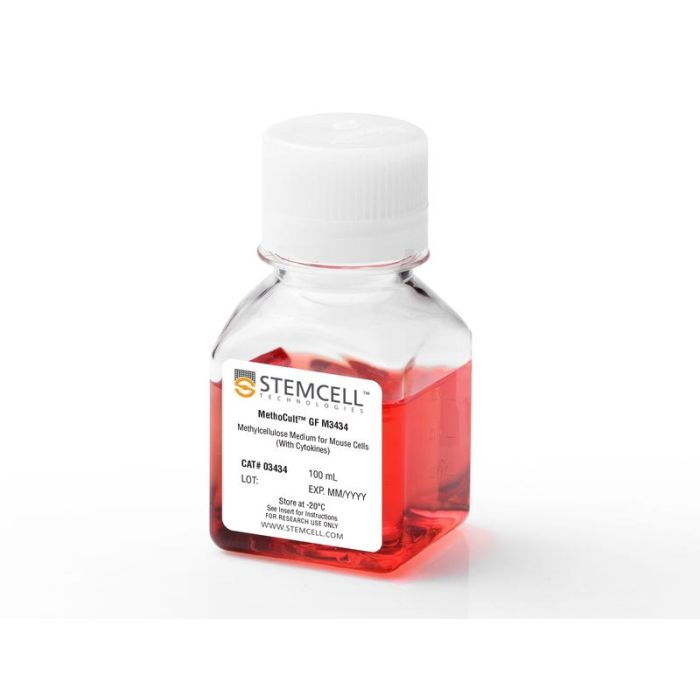
MethoCult™ GF M3434

含重组细胞因子(包括EPO)的甲基纤维素培养基,用于小鼠细胞
只有 %1
¥9,142.00

产品号 #(选择产品)

产品号 #03434_C

含重组细胞因子(包括EPO)的甲基纤维素培养基,用于小鼠细胞

总览

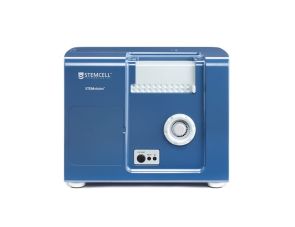
MethoCult™GF M3434针对在小鼠骨髓、脾脏、外周血和胎肝细胞集落形成单位(CFU)检测中造血祖细胞的生长和计数进行优化。MethoCult™GF M3434的配方支持原始红系祖细胞(BFU-E)、粒细胞-巨噬细胞祖细胞(CFU-GM、CFU-G和CFU-M)和多潜能的粒细胞-红系-巨噬细胞-巨核细胞祖细胞(CFU-GEMM)的最佳生长。该配方与STEMvision™软件兼容,用于小鼠骨髓CFU检测的自动集落计数。

参阅关于进行CFU实验的常见问题和解答(FAQ)。

包含
• 含甲基纤维素的Iscove's MDM
• 胎牛血清
• 牛血清白蛋白
• 重组人胰岛素
• 人转铁蛋白(铁饱和)
• 2-巯基乙醇
• 重组小鼠干细胞因子 (SCF)
• 重组小鼠白细胞介素3 (IL-3)
• 重组人白细胞介素6 (IL-6)
• 重组人促红细胞生成素 (EPO)
• 添加物
 
分类
半固体培养基,专用培养基
 
细胞类型
造血干/祖细胞
 
种属
小鼠
 
应用
细胞培养,克隆筛选,功能学筛选
 
品牌
MethoCult
 
研究领域
药物发现和毒性检测,干细胞生物学
 
制剂类别
甲基纤维素基
 

实验数据

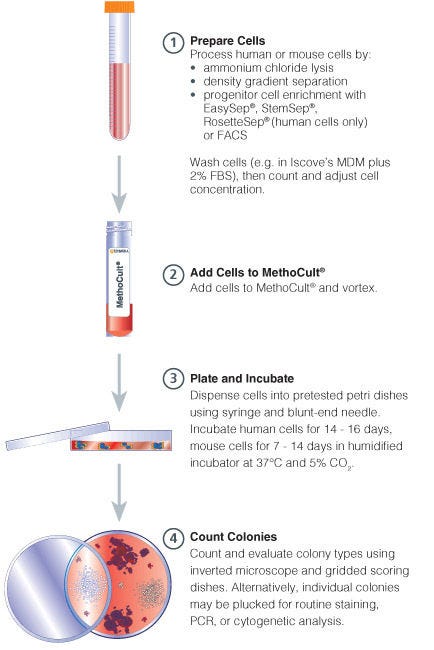
Procedure Summary for Hematopoietic CFU Assays

Figure 1. Procedure Summary for Hematopoietic CFU Assays

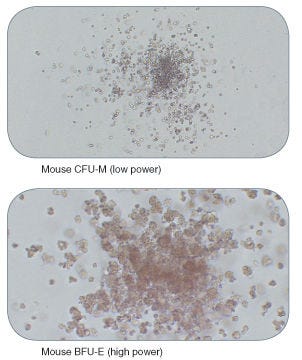
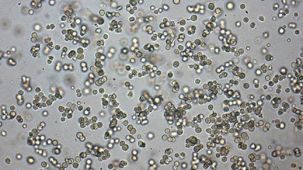
Examples of Colonies Derived from Mouse Hematopoietic Progenitors

Figure 2. Examples of Colonies Derived from Mouse Hematopoietic Progenitors

产品说明书及文档

请在《产品说明书》中查找相关支持信息和使用说明,或浏览下方更多实验方案。

Document Type
Product Name
Catalog #
Lot #
Language
Catalog #
03444, 03434
Lot #
All
Language
English
Document Type
Technical Manual
Catalog #
03434
Lot #
All
Language
English
Document Type
Safety Data Sheet
Catalog #
03444, 03434
Lot #
All
Language
English

应用领域

本产品专为以下研究领域设计,适用于工作流程中的高亮阶段。探索这些工作流程,了解更多我们为各研究领域提供的其他配套产品。

相关材料与文献

技术资料 (8)

常见问题

Why use semi-solid media?

Semi-solid media (methylcellulose-based MethoCult™ and collagen-based MegaCult™-C) allow the clonal progeny of a single progenitor cell to remain spatially isolated from other colonies within a culture, so they may be separately identified and counted.

Why use methylcellulose-based media?

Methylcellulose permits better growth of erythroid colonies than other types of semi-solid support systems (eg. agar) while allowing optimal myeloid colony formation. When appropriate cytokines are present, committed progenitor cells of both erythroid and granulocyte/macrophage lineages (CFU-GM, CFU-G, CFU-M) as well as multi-potential progenitor cells (CFU-GEMM), can be assayed simultaneously in the same culture dish.

Is it necessary to add antibiotics to the media?

No, aseptic technique should be sufficient to maintain sterile cultures. However, antibiotics (eg. Penicillin/Streptomycin) or anti-fungals (eg. Amphotericin B) may be added to the methylcellulose medium if desired.

Is there anything I can do if my cultures appear contaminated?

No, once contamination is visible, it is not possible to rescue the cultures by the addition of antibiotics. Bacteria and yeast inhibit colony formation by depleting nutrients or by releasing toxic substances.

Why can't I use a pipette to dispense methylcellulose-based media?

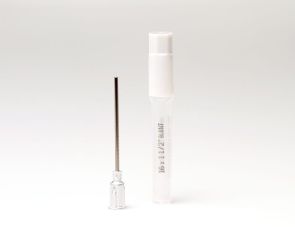
Methylcellulose is a viscous solution that cannot be accurately dispensed using a pipette due to adherence of the medium to the walls of the pipette tip. Blunt-End, 16 Gauge needles (Catalog #28110), in combination with 3 cc Syringes (Catalog #28230) are recommended for accurate dispensing of MethoCult™.

Can I 'pluck' the colonies for individual analysis?

Yes, colonies can be 'plucked' using a pipette with 200 µL sterile pipette tips or using a glass Pasteur pipette with an elongated tip. Individual colonies should be placed in a volume of 25 - 50 µL of medium, and diluted into suitable culture medium for further culture or analysis.

Why are low adherence dishes so important?

Adherent cells such as fibroblasts can cause inhibition of colony growth and obscure visualization of colonies.

Can MethoCult™ products be used for lymphoid progenitor CFU assays?

Human lymphoid progenitors (B, NK and T) seem to require stromal support for growth therefore cannot be grown in MethoCult™. Mouse pre-B clonogenic progenitors can be grown in MethoCult™ M3630 (Catalog #03630).

Is it possible to set up CFU assays in a 24-well plate?

Yes, as long as a plating concentration optimized for the smaller surface area of a well in a 24-well plate (1.9 cm2 as compared to ~9.5 cm2 for a 35 mm dish) is used for these assays. The number of replicate wells required to get an accurate estimation of CFU numbers may also need to be increased.

Can I stain colonies in MethoCult™ medium?

The cells in individual colonies in MethoCult™ can be stained, eg., for analysis of morphology or phenotype, after they are plucked from the dish and washed free of methylcellulose. Colonies grown in collagen-based MegaCult™-C medium can be used for immunohistochemical or enzymatic staining in situ after dehydration and fixation onto glass slides.

Are there differences in colony morphology with serum-free media?

Serum-containing media generally give better overall growth (colonies may appear larger) but there are no large differences in total colony numbers when CFU assays using serum-free media and serum-containing media are compared, provided that identical cytokines are present.

Can MethoCult™ be made with alternate base media?

Yes, this can be done as a 'custom' media order. Please contact techsupport@stemcell.com for more information.

Is there a MethoCult™ formulation suitable for HPP-CFC (high proliferative potential colony forming cell)?

Yes, MethoCult™ H4535 (Catalog #04535) can be used for the HPP-CFC assay as it does not contain EPO. The culture period is usually 28 days. It is not necessary to feed these cultures as growth factors in the medium are present in excess. As HPP-CFCs can be quite large, overplating can be a problem. It is recommended to plate cells at two or more different concentrations.

文献 (194)

Pax7 is required for the specification of myogenic satellite cells. Seale P et al. Cell 2000 SEP

Abstract

The paired box transcription factor Pax7 was isolated by representational difference analysis as a gene specifically expressed in cultured satellite cell-derived myoblasts. In situ hybridization revealed that Pax7 was also expressed in satellite cells residing in adult muscle. Cell culture and electron microscopic analysis revealed a complete absence of satellite cells in Pax7(-/-) skeletal muscle. Surprisingly,fluorescence-activated cell sorting analysis indicated that the proportion of muscle-derived stem cells was unaffected. Importantly,stem cells from Pax7(-/-) muscle displayed almost a 10-fold increase in their ability to form hematopoietic colonies. These results demonstrate that satellite cells and muscle-derived stem cells represent distinct cell populations. Together these studies suggest that induction of Pax7 in muscle-derived stem cells induces satellite cell specification by restricting alternate developmental programs.
Thermal injury increases the number of eosinophil progenitors in rat spleen and bone marrow. Noel JG et al. Inflammation 2001 OCT

Abstract

We have investigated the effects of thermal injury upon myelopoiesis. IL-3,GM-CSF,and IL-5 were used to stimulate myeloid colony formation. IL-3 induces early myeloid progenitors and a more developed myeloid progenitor,the granulocyte-macrophage colony-forming unit (GM-CFU),to multiply and develop into mature myeloid cells. GM-CSF induces GM-CFU to become mature myeloid cells,while IL-5 induces eosinophil progenitors to become mature eosinophils. Stem Cell Factor (SCF) + IL-6 and FLT3 ligand,which have no effect on colony formation by themselves,were used to enhance the effects of IL-3 and GM-CSF,respectively. We found that thermal injury increased the number of early myeloid progenitors and GM-CFU in the spleen with either IL-3 or GM-CSF as a stimulant. Thermal injury increased the number of early myeloid progenitors in the bone marrow when GM-CSF,but not IL-3,was used to stimulate colony growth. Also,thermal injury increased the numbers of eosinophil progenitors in rat spleen and bone marrow and increased splenic levels of IL-5 mRNA.
Hematopoietic stem cells differentiate into vascular cells that participate in the pathogenesis of atherosclerosis. Sata M et al. Nature medicine 2002 APR

Abstract

Excessive accumulation of smooth-muscle cells (SMCs) has a key role in the pathogenesis of vascular diseases. It has been assumed that SMCs derived from the outer medial layer migrate,proliferate and synthesize extracellular matrix components on the luminal side of the vessel. Although much effort has been devoted to targeting migration and proliferation of medial SMCs,there is no effective therapy that prevents occlusive vascular remodeling. We show here that in models of post-angioplasty restenosis,graft vasculopathy and hyperlipidemia-induced atherosclerosis,bone-marrow cells give rise to most of the SMCs that contribute to arterial remodeling. Notably,purified hematopoietic stem cells differentiate into SMCs in vitro and in vivo. Our findings indicate that somatic stem cells contribute to pathological remodeling of remote organs,and may provide the basis for the development of new therapeutic strategies for vascular diseases through targeting mobilization,homing,differentiation and proliferation of bone marrow-derived vascular progenitor cells.

更多信息

更多信息
物种 小鼠
Contains • Methylcellulose in Iscove's MDM • Fetal bovine serum • Bovine serum albumin • Recombinant human insulin • Human transferrin (iron-saturated) • 2-Mercaptoethanol • Recombinant mouse stem cell factor (SCF) • Recombinant mouse interleukin 3 (IL-3) • Recomb
配方 甲基纤维素基
质量保证:

产品仅供研究使用,不用于针对人或动物的诊断或治疗。 欲获悉更多关于STEMCELL的质控信息,请访问 STEMCELL.CN/COMPLIANCE.
Copyright © 2026 by STEMCELL Technologies. All rights reserved.

在线联系