若您需要咨询产品或有任何技术问题,请通过官方电话 400 885 9050 或邮箱 info.cn@stemcell.com 与我们联系。

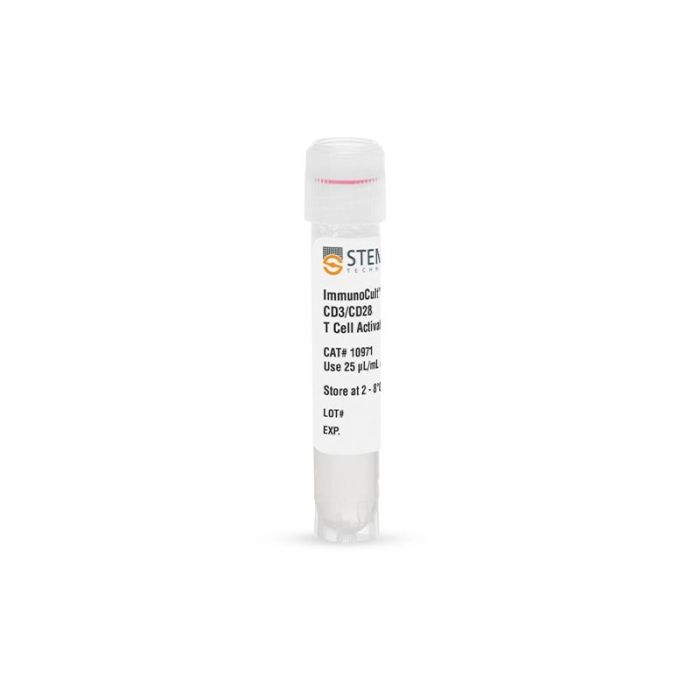
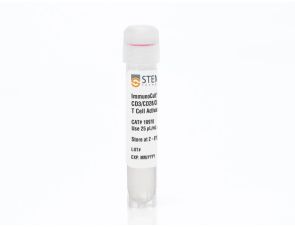
ImmunoCult™ 人CD3/CD28 T细胞激活剂

人T细胞激活扩增试剂
只有 %1
¥2,256.00

产品号 #(选择产品)

产品号 #10971_C

人T细胞激活扩增试剂

产品优势

  • 无需使用磁珠、饲养细胞或抗原,即可高效地激活和扩增人T细胞
  • 提供温和的激活刺激,维持激活和扩增后T细胞的高活性
  • 高度稳定,过滤灭菌的可溶性试剂

What Our Scientist Says

We want to make it easier to activate and expand human T cells while still maintaining a high viability of these cells. That's why we developed ImmunoCult™ Human CD3/CD28 T Cell Activator.

Jessie YuScientist
Jessie Yu, Scientist

总览

在无磁珠、饲养细胞或抗原的体系下,实现T细胞的稳定激活和扩增。

该产品温和的激活刺激效果可确保活化T细胞的高活性,并可在ImmunoCult™-XF T细胞扩增培养基(产品号 #10981)或其它用于培养人T细胞的培养基中进一步扩增。抗体复合物结合并交联细胞表面配体CD3和CD28,从而为T细胞激活提供所需的信号。ImmunoCult™人CD3/CD28 T细胞激活剂可用于Seahorse XF分析仪检测T细胞激活反应,也可作为安捷伦Seahorse XF 人T细胞激活检测试剂盒的一部分。

本产品专为研究应用而设计。如果您需要适用于细胞治疗生产的试剂,ImmunoCult™人 CD3/CD28 T细胞激活剂(产品号 #100-0784)符合相关GMP要求。

包含
• 抗人CD3单特异性抗体复合物
• 抗人CD28单特异性抗体复合物
 
分类
添加剂
 
细胞类型
T 细胞,T 细胞,CD4+,T 细胞,CD8+
 
种属

 
应用
激活,细胞培养,扩增
 
品牌
ImmunoCult
 
研究领域
细胞疗法开发,药物发现和毒性检测,免疫学
 

实验数据

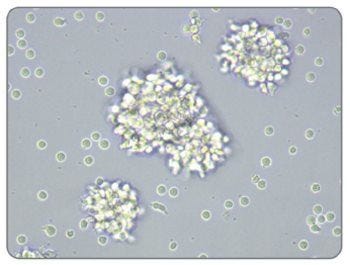
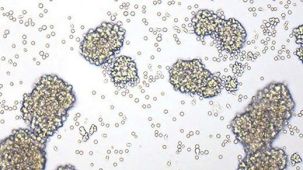
Activated Morphology of Human T Cells Stimulated With ImmunoCult™ Human CD3/CD28 T Cell Activator

Figure 1. Activated Morphology of Human T Cells Stimulated With ImmunoCult™ Human CD3/CD28 T Cell Activator

Image of human T cells isolated using the EasySep™ Human T Cell Isolation Kit (Catalog #17951), stimulated with ImmunoCult™ Human CD3/CD28 T Cell Activator, and cultured in ImmunoCult™-XF T Cell Expansion Medium (Catalog # 10981).

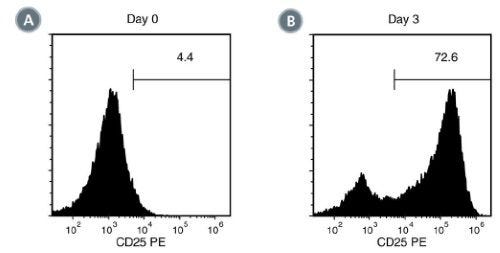
Activation of Human T Cells stimulated With ImmunoCult™ Human CD3/CD28 T Cell Activator

Figure 2. Activation of EasySep™-isolated Human T Cells stimulated With ImmunoCult™ Human CD3/CD28 T Cell Activator

EasySep™-isolated human T cells were stimulated with ImmunoCult™ Human CD3/CD28 T Cell Activator and cultured in ImmunoCult™-XF T Cell Expansion Medium. Activation of viable CD3+ T cells was assessed by CD25 expression using flow cytometry. On day 0, the frequency of CD25 positive cells was (A) 5.6 ± 2.4% (mean ± SD). Following 3 days of culture, the frequency of CD25 positive cells was (B) 75.4 ± 13.8% (mean ± SD) when stimulated with ImmunoCult™ Human CD3/CD28 T Cell Activator.

Robust Human T Cell Expansion with ImmunoCult™ Human CD3/CD28 T Cell Activator

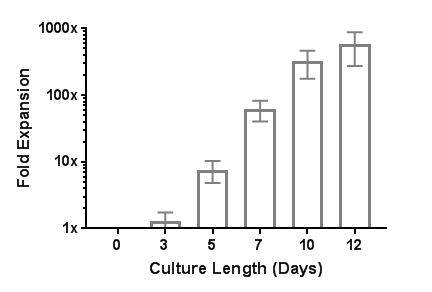
Figure 3. Robust Human T Cell Expansion with ImmunoCult™ Human CD3/CD28 T Cell Activator

EasySep™-isolated human T cells were expanded over 12 days with ImmunoCult™ Human CD3/CD28 T Cell Activator in ImmunoCult™-XF T Cell Expansion Medium supplemented with Human Recombinant IL-2. On day 0, 1 x 10^6 EasySep™-isolated human T cells were stimulated with 25 μL of ImmunoCult™ Human CD3/CD28 T Cell Activator in ImmunoCult™-XF T Cell Expansion Medium supplemented with 10 ng/mL Human Recombinant IL-2. On days 3, 5, 7, and 10, viable cells were counted and fresh medium supplemented with IL-2 was added. No additional ImmunoCult™ Human CD3/CD28 T Cell Activator was added during the 12-day culture period (mean ± SD in 6 experiments with 3 donors).

产品说明书及文档

请在《产品说明书》中查找相关支持信息和使用说明,或浏览下方更多实验方案。

Document Type
Product Name
Catalog #
Lot #
Language
Catalog #
10971, 10991
Lot #
All
Language
English
Document Type
Safety Data Sheet
Catalog #
10971, 10991
Lot #
All
Language
English

应用领域

本产品专为以下研究领域设计,适用于工作流程中的高亮阶段。探索这些工作流程,了解更多我们为各研究领域提供的其他配套产品。

相关材料与文献

技术资料 (21)

文献 (46)

Eradication of Triple-Negative Breast Cancer Cells by Targeting Glycosylated PD-L1. C.-W. Li et al. Cancer cell 2018 FEB

Abstract

Protein glycosylation provides proteomic diversity in regulating protein localization,stability,and activity; it remains largely unknown whether the sugar moiety contributes to immunosuppression. In the study of immune receptor glycosylation,we showed that EGF induces programmed death ligand 1 (PD-L1) and receptor programmed cell death protein 1 (PD-1) interaction,requiring beta$-1,3-N-acetylglucosaminyl transferase (B3GNT3) expression in triple-negative breast cancer. Downregulation of B3GNT3 enhances cytotoxic T cell-mediated anti-tumor immunity. A monoclonal antibody targeting glycosylated PD-L1 (gPD-L1) blocks PD-L1/PD-1 interaction and promotes PD-L1 internalization and degradation. In addition to immune reactivation,drug-conjugated gPD-L1 antibody induces a potent cell-killing effect as well as a bystander-killing effect on adjacent cancer cells lacking PD-L1 expression without any detectable toxicity. Our work suggests targeting protein glycosylation as a potential strategy to enhance immune checkpoint therapy.
Translational control of tumor immune escape via the eIF4F-STAT1-PD-L1 axis in melanoma. M. Cerezo et al. Nature medicine 2018 OCT

Abstract

Preventing the immune escape of tumor cells by blocking inhibitory checkpoints,such as the interaction between programmed death ligand-1 (PD-L1) and programmed death-1 (PD-1) receptor,is a powerful anticancer approach. However,many patients do not respond to checkpoint blockade. Tumor PD-L1 expression is a potential efficacy biomarker,but the complex mechanisms underlying its regulation are not completely understood. Here,we show that the eukaryotic translation initiation complex,eIF4F,which binds the 5' cap of mRNAs,regulates the surface expression of interferon-$\gamma$-induced PD-L1 on cancer cells by regulating translation of the mRNA encoding the signal transducer and activator of transcription 1 (STAT1) transcription factor. eIF4F complex formation correlates with response to immunotherapy in human melanoma. Pharmacological inhibition of eIF4A,the RNA helicase component of eIF4F,elicits powerful antitumor immune-mediated effects via PD-L1 downregulation. Thus,eIF4A inhibitors,in development as anticancer drugs,may also act as cancer immunotherapies.
Gut-Liver Physiomimetics Reveal Paradoxical Modulation of IBD-Related Inflammation by Short-Chain Fatty Acids. M. Trapecar et al. Cell systems 2020 mar

Abstract

Although the association between the microbiome and IBD and liver diseases is known,the cause and effect remain elusive. By connecting human microphysiological systems of the gut,liver,and circulating Treg and Th17 cells,we created a multi-organ model of ulcerative colitis (UC) ex vivo. The approach shows microbiome-derived short-chain fatty acids (SCFAs) to either improve or worsen UC severity,depending on the involvement of effector CD4 T cells. Using multiomics,we found SCFAs increased production of ketone bodies,glycolysis,and lipogenesis,while markedly reducing innate immune activation of the UC gut. However,during acute T cell-mediated inflammation,SCFAs exacerbated CD4+ T cell-effector function,partially through metabolic reprograming,leading to gut barrier disruption and hepatic injury. These paradoxical findings underscore the emerging utility of human physiomimetic technology in combination with systems immunology to study causality and the fundamental entanglement of immunity,metabolism,and tissue homeostasis.

更多信息

更多信息
物种
Contains • Anti-human CD3 monospecific antibody complex • Anti-human CD28 monospecific antibody complex
质量保证:

产品仅供研究使用,不用于针对人或动物的诊断或治疗。 欲获悉更多关于STEMCELL的质控信息,请访问 STEMCELL.CN/COMPLIANCE.
Copyright © 2026 by STEMCELL Technologies. All rights reserved.

在线联系