Simple suspension culture system of human iPS cells maintaining their pluripotency for cardiac cell sheet engineering. Haraguchi Y et al.
Journal of Tissue Engineering and Regenerative Medicine 2015 DEC
Abstract
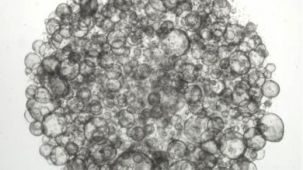
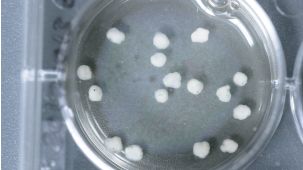
In this study,a simple three-dimensional (3D) suspension culture method for the expansion and cardiac differentiation of human induced pluripotent stem cells (hiPSCs) is reported. The culture methods were easily adapted from two-dimensional (2D) to 3D culture without any additional manipulations. When hiPSCs were directly applied to 3D culture from 2D in a single-cell suspension,only a few aggregated cells were observed. However,after 3 days,culture of the small hiPSC aggregates in a spinner flask at the optimal agitation rate created aggregates which were capable of cell passages from the single-cell suspension. Cell numbers increased to approximately 10-fold after 12 days of culture. The undifferentiated state of expanded hiPSCs was confirmed by flow cytometry,immunocytochemistry and quantitative RT-PCR,and the hiPSCs differentiated into three germ layers. When the hiPSCs were subsequently cultured in a flask using cardiac differentiation medium,expression of cardiac cell-specific genes and beating cardiomyocytes were observed. Furthermore,the culture of hiPSCs on Matrigel-coated dishes with serum-free medium containing activin A,BMP4 and FGF-2 enabled it to generate robust spontaneous beating cardiomyocytes and these cells expressed several cardiac cell-related genes,including HCN4,MLC-2a and MLC-2v. This suggests that the expanded hiPSCs might maintain the potential to differentiate into several types of cardiomyocytes,including pacemakers. Moreover,when cardiac cell sheets were fabricated using differentiated cardiomyocytes,they beat spontaneously and synchronously,indicating electrically communicative tissue. This simple culture system might enable the generation of sufficient amounts of beating cardiomyocytes for use in cardiac regenerative medicine and tissue engineering.
A systematic evaluation of integration free reprogramming methods for deriving clinically relevant patient specific induced pluripotent stem (iPS) cells Goh PA et al.
PLoS ONE 2013 NOV
Abstract
A systematic evaluation of three different methods for generating induced pluripotent stem (iPS) cells was performed using the same set of parental cells in our quest to develop a feeder independent and xeno-free method for somatic cell reprogramming that could be transferred into a GMP environment. When using the BJ fibroblast cell line,the highest reprogramming efficiency (1.89% of starting cells) was observed with the mRNA based method which was almost 20 fold higher than that observed with the retrovirus (0.2%) and episomal plasmid (0.10%) methods. Standard characterisation tests did not reveal any differences in an array of pluripotency markers between the iPS lines derived using the various methods. However,when the same methods were used to reprogram three different primary fibroblasts lines,two derived from patients with rapid onset parkinsonism dystonia and one from an elderly healthy volunteer,we consistently observed higher reprogramming efficiencies with the episomal plasmid method,which was 4 fold higher when compared to the retroviral method and over 50 fold higher than the mRNA method. Additionally,with the plasmid reprogramming protocol,recombinant vitronectin and synthemax® could be used together with commercially available,fully defined,xeno-free essential 8 medium without significantly impacting the reprogramming efficiency. To demonstrate the robustness of this protocol,we reprogrammed a further 2 primary patient cell lines,one with retinosa pigmentosa and the other with Parkinsons disease. We believe that we have optimised a simple and reproducible method which could be used as a starting point for developing GMP protocols,a prerequisite for generating clinically relevant patient specific iPS cells.
Deriving functional hepatocytes from pluripotent stem cells. Szkolnicka D et al.
Current protocols in stem cell biology 2014
Abstract
Despite major progress in the management of human liver disease,the only cure for a critically failing organ is liver transplantation. While a highly successful approach,the use of cadaveric organs as a routine treatment option is severely limited by organ availability. Therefore,the use of cell-based therapies has been explored to provide support for the failing liver. In addition to developing new treatments,there is also an imperative to develop better human models 'in a dish'. Such approaches will undoubtedly lead to a better understanding of the disease process,offering new treatment or preventative strategies. With both approaches in mind,we have developed robust hepatocyte differentiation methodologies for use with pluripotent stem cells. Importantly,our procedure is highly efficient (∼ 90%) and delivers active,drug-inducible,and predictive human hepatocyte populations.
Thank you for your interest in IntestiCult™ Organoid Growth Medium (Human). Please provide us with your contact information and your local representative will contact you with a customized quote. Where appropriate, they
can also assist you with a(n):
Estimated delivery time for your area
Product sample or exclusive offer
In-lab demonstration
By submitting this form, you are providing your consent to STEMCELL Technologies Canada Inc. and its subsidiaries and affiliates (“STEMCELL”) to collect and use your information, and send you newsletters and emails in accordance with our
privacy policy. Please contact us with any questions that you may have. You can unsubscribe or change your email preferences at any time.
THIS PRODUCT IS MANUFACTURED AND TESTED FOLLOWING RELEVANT CGMPs UNDER A CERTIFIED QUALITY MANAGEMENT SYSTEM. PRODUCT IS FOR FURTHER MANUFACTURING OR RESEARCH USE. NOT INTENDED FOR HUMAN OR ANIMAL DIAGNOSTIC OR THERAPEUTIC USES UNLESS OTHERWISE STATED. 欲获悉更多关于STEMCELL的质控信息,请访问 WWW.STEMCELL.COM/COMPLIANCE