若您需要咨询产品或有任何技术问题,请通过官方电话 400 885 9050 或邮箱 info.cn@stemcell.com 与我们联系。

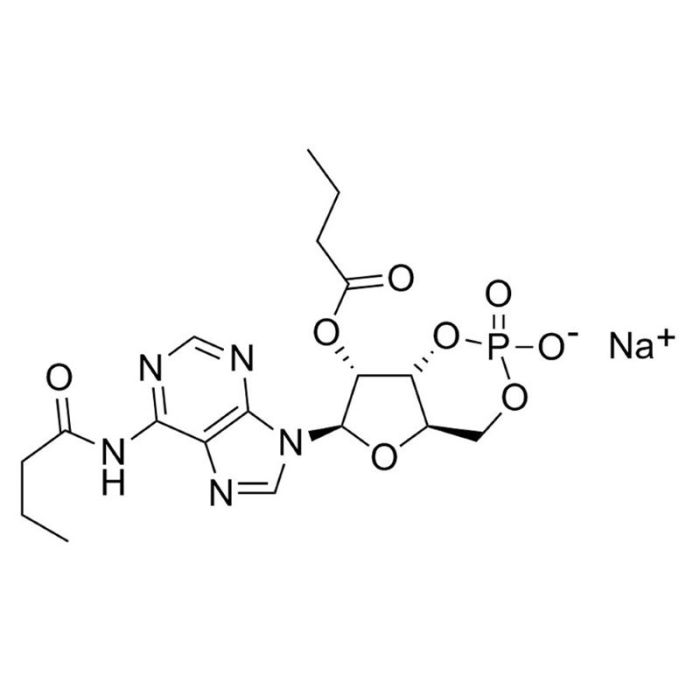
二丁酰(Dibutyryl)-cAMP

cAMP通路激活剂;激活cAMP依赖性蛋白激酶
只有 %1 左
¥898.00

产品号 #(选择产品)

产品号 #73882_C

cAMP通路激活剂;激活cAMP依赖性蛋白激酶

总览

二丁酰(Dibutyryl)-cAMP是一种可透过细胞的环AMP(cAMP)类似物,可激活cAMP依赖性蛋白激酶(Schwede et al.)。本产品以该分子的钠盐形式提供。


分化
·通过减少脱髓鞘并动员脑室下区神经干细胞向脱髓鞘斑块方向移动,抑制实验性自身免疫性脑脊髓炎的发展(Khezri et al.)。

·诱导外周和中枢神经系统的内在轴突生长,以及星形胶质细胞的形态分化(Knott et al.; Imamura & Ozawa)。

·刺激PC12细胞的神经突生长(Maruoka et al.)。

别名
布克拉德辛;DC 2797
 
细胞类型
星形胶质细胞,神经细胞,PSC衍生,神经元
 
种属
人,小鼠,非人灵长类,其他物种,大鼠
 
应用
分化,扩增
 
研究领域
疾病建模,神经科学
 
CAS 编号
16980-89-5
 
化学式
C₁₈H₂₃N₅O₈P · Na
 
分子量
491.4 g/mol
 
纯度
≥ 95 %
 
通路
cAMP
 
靶点
cAMP依赖性激酶
 

产品说明书及文档

请在《产品说明书》中查找相关支持信息和使用说明,或浏览下方更多实验方案。

Document Type
Product Name
Catalog #
Lot #
Language
Product Name
Dibutyryl-cAMP
Catalog #
73886, 73882, 73884, 100-0244
Lot #
All
Language
English
Document Type
Safety Data Sheet
Product Name
Dibutyryl-cAMP
Catalog #
73886, 73882, 73884
Lot #
All
Language
English
Document Type
Safety Data Sheet
Product Name
Dibutyryl-cAMP
Catalog #
100-0244
Lot #
All
Language
English

应用领域

本产品专为以下研究领域设计,适用于工作流程中的高亮阶段。探索这些工作流程,了解更多我们为各研究领域提供的其他配套产品。

相关材料与文献

技术资料 (3)

文献 (5)

Cortical brain organoid slices (cBOS) for the study of human neural cells in minimal networks L. Petersilie et al. iScience 2024 Mar

Abstract

Brain organoids derived from human pluripotent stem cells are a promising tool for studying human neurodevelopment and related disorders. Here,we generated long-term cultures of cortical brain organoid slices (cBOS) grown at the air-liquid interphase from regionalized cortical organoids. We show that cBOS host mature neurons and astrocytes organized in complex architecture. Whole-cell patch-clamp demonstrated subthreshold synaptic inputs and action potential firing of neurons. Spontaneous intracellular calcium signals turned into synchronous large-scale oscillations upon combined disinhibition of NMDA receptors and blocking of GABA A receptors. Brief metabolic inhibition to mimic transient energy restriction in the ischemic brain induced reversible intracellular calcium loading of cBOS. Moreover,metabolic inhibition induced a reversible decline in neuronal ATP as revealed by ATeam1.03 YEMK . Overall,cBOS provide a powerful platform to assess morphological and functional aspects of human neural cells in intact minimal networks and to address the pathways that drive cellular damage during brain ischemia. Subject areas: Neuroscience,Cellular neuroscience,Stem cells research
Plekhg5 controls the unconventional secretion of Sod1 by presynaptic secretory autophagy A. Hutchings et al. Nature Communications 2024 Oct

Abstract

Increasing evidence suggests an essential function for autophagy in unconventional protein secretion (UPS). However,despite its relevance for the secretion of aggregate-prone proteins,the mechanisms of secretory autophagy in neurons have remained elusive. Here we show that the lower motoneuron disease-associated guanine exchange factor Plekhg5 drives the UPS of Sod1. Mechanistically,Sod1 is sequestered into autophagosomal carriers,which subsequently fuse with secretory lysosomal-related organelles (LROs). Exocytosis of LROs to release Sod1 into the extracellular milieu requires the activation of the small GTPase Rab26 by Plekhg5. Deletion of Plekhg5 in mice leads to the accumulation of Sod1 in LROs at swollen presynaptic sites. A reduced secretion of toxic ALS-linked SOD1G93A following deletion of Plekhg5 in SOD1G93A mice accelerated disease onset while prolonging survival due to an attenuated microglia activation. Using human iPSC-derived motoneurons we show that reduced levels of PLEKHG5 cause an impaired secretion of ALS-linked SOD1. Our findings highlight an unexpected pathophysiological mechanism that converges two motoneuron disease-associated proteins into a common pathway. Unconventional protein secretion emerges as an important mechanism in aggregate-prone protein removal. Here,the authors demonstrate that Plekhg5 mediates the unconventional secretion of Sod1 by presynaptic secretory autophagy.
Axonal tau reduction ameliorates tau and amyloid pathology in a mouse model of Alzheimer’s disease Translational Neurodegeneration 2025 Jul

Abstract

BackgroundPathological deposition of hyperphosphorylated tau in the brain closely correlates with the course of Alzheimer’s disease (AD). Tau pathology occurs in axons of affected neurons and tau removal from axons might thus be an early intervention strategy.MethodsWe investigated the role of the RNA-binding protein hnRNP R in axonal localization and local translation of Mapt mRNA in neurons cultured from hnRNP R knockout mice. hnRNP R knockout mice were crossed with 5×FAD mice,an AD mouse model,and the effects of hnRNP R loss on the deposition of phospho-tau and amyloid-? plaques were evaluated. We designed antisense oligonucleotides (MAPT-ASOs) to block the binding of hnRNP R to Mapt mRNA. Cultured mouse and human neurons were treated with MAPT-ASOs and axonal Mapt mRNA and tau protein levels were quantified. MAPT-ASO was injected intracerebroventricularly into 5×FAD mice followed by quantification of phospho-tau aggregates and amyloid-? plaques in their brains. Protein changes in brains of 5×FAD mice treated with the MAPT-ASO were measured by mass spectrometry.ResultsMapt mRNA and tau protein were reduced in axons but not cell bodies of primary neurons cultured from hnRNP R knockout mice. Brains of 5×FAD mice deficient for hnRNP R contained less phospho-tau aggregates and amyloid-? plaques in the cortex and hippocampus. Treatment of neurons with MAPT-ASOs to block hnRNP R binding to Mapt similarly reduced axonal tau levels. Intracerebroventricular injection of a MAPT-ASO reduced the phospho-tau and plaque load and prevented neurodegeneration in the brains of 5×FAD mice,accompanied by rescue of proteome alterations.ConclusionLowering of tau selectively in axons thus represents an innovative therapeutic perspective for treatment of AD and other tauopathies.Supplementary InformationThe online version contains supplementary material available at 10.1186/s40035-025-00499-0.

更多信息

更多信息
Molecular Weight 491.4 g/mol
物种 人, 其它物种, 大鼠, 小鼠, 非人灵长类
Alternative Names Bucladesine; DC 2797
Cas Number 16980-89-5
Chemical Formula C₁₈H₂₃N₅O₈P · Na
纯度 ≥ 95 %
Target cAMP-Dependent Kinase
Pathway cAMP
质量保证:

产品仅供研究使用,不用于针对人或动物的诊断或治疗。
Copyright © 2026 by STEMCELL Technologies. All rights reserved.

在线联系