若您需要咨询产品或有任何技术问题,请通过官方电话 400 885 9050 或邮箱 info.cn@stemcell.com 与我们联系。

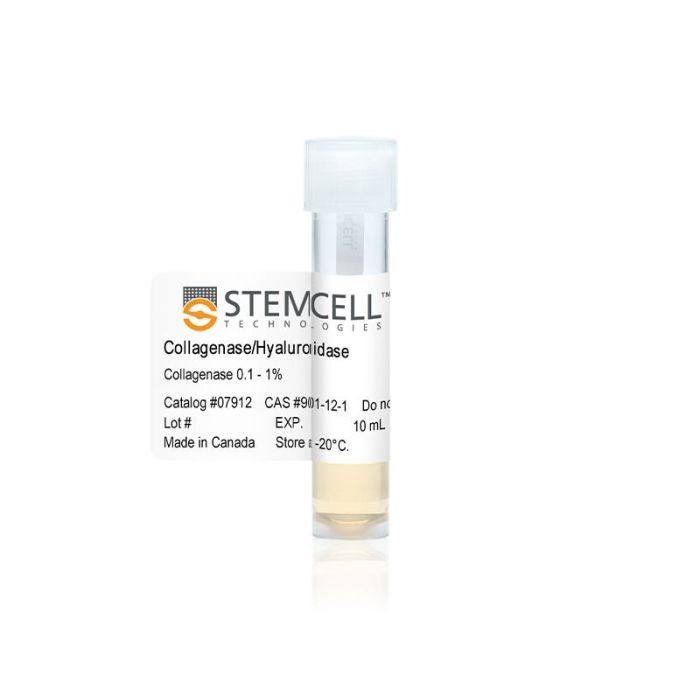
胶原酶/透明质酸酶

配置于DMEM中的10 X 胶原酶/透明质酸酶
只有 %1
¥3,776.00

产品号 #(选择产品)

产品号 #07912_C

配置于DMEM中的10 X 胶原酶/透明质酸酶

产品优势

  • 有效分离人乳腺组织和前列腺上皮细胞

总览

使用配置于Dulbecco 's Modified Eagle 's Medium (DMEM)中的10X胶原酶/透明质酸酶酶解人乳腺细胞。该蛋白酶/多糖酶组合可以消化天然胶原纤维,并水解结缔组织中的透明质酸,从而有效地解离组织。胶原酶/透明质酸酶也可用于前列腺上皮细胞的酶解。

包含
• 3000 U/mL胶原酶
• 1000 U/mL透明质酸酶
• DMEM (1000 mg D-葡萄糖/L)
 
分类
酶法相关(或酶解类产品)
 
细胞类型
乳腺细胞,其他物种,前列腺细胞
 
种属
人,小鼠,非人灵长类,其他物种,大鼠
 
应用
细胞培养
 
研究领域
上皮细胞研究
 

产品说明书及文档

请在《产品说明书》中查找相关支持信息和使用说明,或浏览下方更多实验方案。

Document Type
Product Name
Catalog #
Lot #
Language
Catalog #
07912
Lot #
All
Language
English
Document Type
Safety Data Sheet
Catalog #
07912
Lot #
All
Language
English

应用领域

本产品专为以下研究领域设计,适用于工作流程中的高亮阶段。探索这些工作流程,了解更多我们为各研究领域提供的其他配套产品。

相关材料与文献

技术资料 (2)

文献 (26)

Silica bioreplication preserves three-dimensional spheroid structures of human pluripotent stem cells and HepG2 cells. Lou Y-R et al. Scientific reports 2015 SEP

Abstract

Three-dimensional (3D) cell cultures produce more in vivo-like multicellular structures such as spheroids that cannot be obtained in two-dimensional (2D) cell cultures. Thus,they are increasingly employed as models for cancer and drug research,as well as tissue engineering. It has proven challenging to stabilize spheroid architectures for detailed morphological examination. Here we overcome this issue using a silica bioreplication (SBR) process employed on spheroids formed from human pluripotent stem cells (hPSCs) and hepatocellular carcinoma HepG2 cells cultured in the nanofibrillar cellulose (NFC) hydrogel. The cells in the spheroids are more round and tightly interacting with each other than those in 2D cultures,and they develop microvilli-like structures on the cell membranes as seen in 2D cultures. Furthermore,SBR preserves extracellular matrix-like materials and cellular proteins. These findings provide the first evidence of intact hPSC spheroid architectures and similar fine structures to 2D-cultured cells,providing a pathway to enable our understanding of morphogenesis in 3D cultures.
Epigenomic analyses identify FOXM1 as a key regulator of anti-tumor immune response in esophageal adenocarcinoma B. Ziman et al. Cell Death & Disease 2024 Feb

Abstract

Unlike most cancer types,the incidence of esophageal adenocarcinoma (EAC) has rapidly escalated in the western world over recent decades. Using whole genome bisulfite sequencing (WGBS),we identify the transcription factor (TF) FOXM1 as an important epigenetic regulator of EAC. FOXM1 plays a critical role in cellular proliferation and tumor growth in EAC patient-derived organoids and cell line models. We identify ERBB2 as an upstream regulator of the expression and transcriptional activity of FOXM1. Unexpectedly,gene set enrichment analysis (GSEA) unbiased screen reveals a prominent anti-correlation between FOXM1 and immune response pathways. Indeed,syngeneic mouse models show that FOXM1 inhibits the infiltration of CD8+ T cells into the tumor microenvironment. Consistently,FOXM1 suppresses CD8+ T cell chemotaxis in vitro and antigen-dependent CD8+ T cell killing. This study characterizes FOXM1 as a significant EAC-promoting TF and elucidates its novel function in regulating anti-tumor immune response.
Downregulation of IRF8 in alveolar macrophages by G-CSF promotes metastatic tumor progression S. Tzetzo et al. iScience 2024 Feb

Abstract

SummaryTissue-resident macrophages (TRMs) are abundant immune cells within pre-metastatic sites,yet their functional contributions to metastasis remain incompletely understood. Here,we show that alveolar macrophages (AMs),the main TRMs of the lung,are susceptible to downregulation of the immune stimulatory transcription factor IRF8,impairing anti-metastatic activity in models of metastatic breast cancer. G-CSF is a key tumor-associated factor (TAF) that acts upon AMs to reduce IRF8 levels and facilitate metastasis. Translational relevance of IRF8 downregulation was observed among macrophage precursors in breast cancer and a CD68hiIRF8loG-CSFhi gene signature suggests poorer prognosis in triple-negative breast cancer (TNBC),a G-CSF-expressing subtype. Our data highlight the underappreciated,pro-metastatic roles of AMs in response to G-CSF and identify the contribution of IRF8-deficient AMs to metastatic burden. AMs are an attractive target of local neoadjuvant G-CSF blockade to recover anti-metastatic activity. Graphical abstract Highlights•IRF8 declines in distal macrophages and monocytes during early mammary tumor growth•Loss of IRF8 in AMs serves as a pre-conditioning mechanism for lung metastasis•G-CSF reduces AM IRF8 levels and is a therapeutic target for anti-metastatic activity•A CD68hiIRF8loG-CSFhi gene signature in TNBC patients portends poorer prognosis Microenvironment; Immunology; Cancer

更多信息

更多信息
物种 人, 其它物种, 大鼠, 小鼠, 非人灵长类
Contains • 3000 U/mL Collagenase • 1000 U/mL Hyaluronidase • DMEM (1000 mg D-glucose/L)
质量保证:

产品仅供研究使用,不用于针对人或动物的诊断或治疗。 欲获悉更多关于STEMCELL的质控信息,请访问 STEMCELL.CN/COMPLIANCE.
Copyright © 2026 by STEMCELL Technologies. All rights reserved.

在线联系