若您需要咨询产品或有任何技术问题,请通过官方电话 400 885 9050 或邮箱 info.cn@stemcell.com 与我们联系。

ClonaCell™-HY AOF扩增培养基

含次黄嘌呤和胸苷的杂交瘤扩增培养基(无动物源成分)
只有 %1 左
¥5,622.00

产品号 #(选择产品)

产品号 #03835


含次黄嘌呤和胸苷的杂交瘤扩增培养基(无动物源成分)

产品优势

  • 无动物源成分
  • 不含血清,减少培养基的使用效果差异性
  • 简化下游克隆筛查和抗体纯化流程(无血清来源的IgG)

总览

ClonaCell™-HY AOF扩增培养基是一种无血清、无动物源成分的液体培养基,专为杂交瘤在次黄嘌呤-氨基蝶呤-胸苷(HAT)筛选后的扩增而优化。该培养基含有次黄嘌呤和胸苷(HT),用于使杂交瘤脱离筛选过程中使用的氨基蝶呤。ClonaCell™-HY AOF扩增培养基能促进杂交瘤高效扩增,实现从含血清到无血清培养基的顺利过渡,并能使杂交瘤细胞系的活性和抗体产量稳定。大多数杂交瘤细胞可直接从含血清培养基切换至ClonaCell™-HY AOF扩增培养基,无需适应步骤。无血清的液体培养基有助于检测和纯化来自目的杂交瘤的抗体,避免血清来源免疫球蛋白的干扰。

该培养基已验证适用于小鼠和大鼠杂交瘤,并支持小鼠骨髓瘤(如Sp2/0)、大鼠骨髓瘤(如YB2/0)及人骨髓瘤(如U266)的扩增。在大多数情况下,冻存的杂交瘤可直接解冻至ClonaCell™-HY AOF扩增培养基,同时保持高存活率。本培养基可作为ClonaCell™-HY Medium A(产品号 #03801)或ClonaCell™-HY Medium E(产品号 #03805)的无血清替代方案。该培养基及其成分的生产中,至少在次级原材料水平不含任何动物源或人源成分。

包含
• 次黄嘌呤和胸苷 (HT)
• 庆大霉素
• 酚红
• L-谷氨酰胺及其他添加物
• 其他成分,包括重组蛋白
 
分类
专用培养基
 
细胞类型
杂交瘤细胞
 
种属
人,小鼠,大鼠
 
应用
细胞培养
 
品牌
ClonaCell
 
研究领域
抗体​制备,细胞系制备,杂交瘤制备
 
制剂类别
无血清
 

实验数据

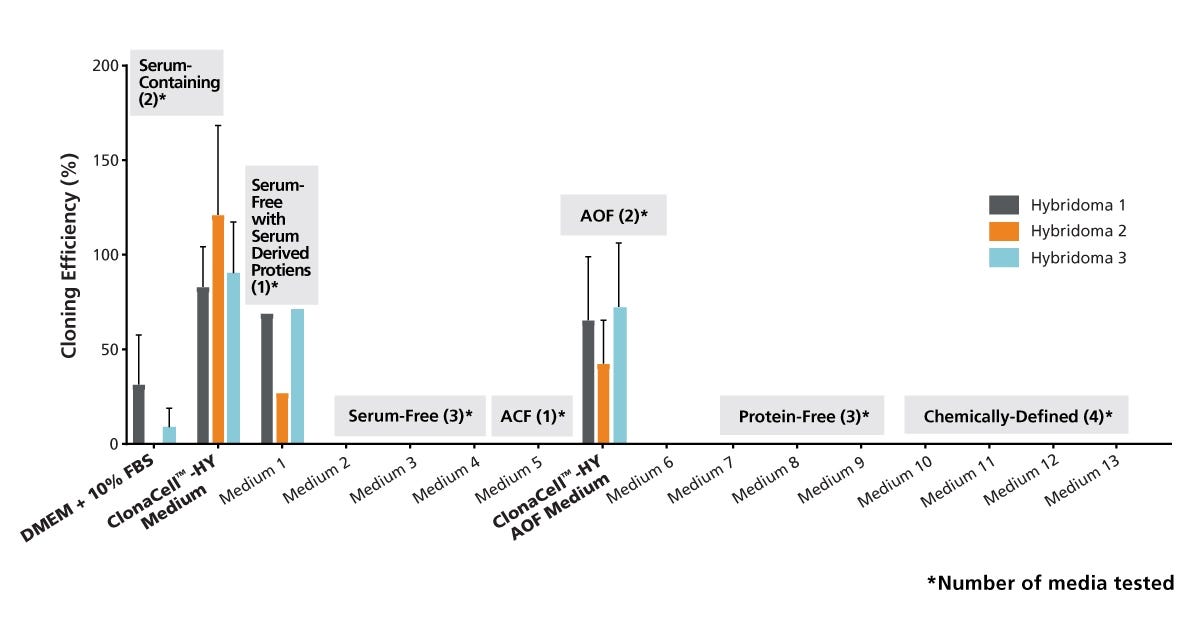
Cloning Efficiencies for Three Hybridoma Cell Lines Subcloned in Serum-containing and Serun-free Cell Culture Media

Figure 1. Cloning Efficiencies for Three Hybridoma Cell Lines Subcloned in Serum-containing and Serum-free Cell Culture Media

The hybridoma lines were adapted to growth in each medium and subcloned by limiting dilution (n = 1 - 5). After incubation for 10 days (37°C, 5% CO2), the plates were analyzed with a Cell Metric™ instrument (Solentim). The plating efficiency was estimated by Poisson statistics using the ELDA method described by Hu & Smith, 2009 (J Immunol Meth, 347: 70-78). ACF = animal component-free. Data is expressed as mean + 1 SD.

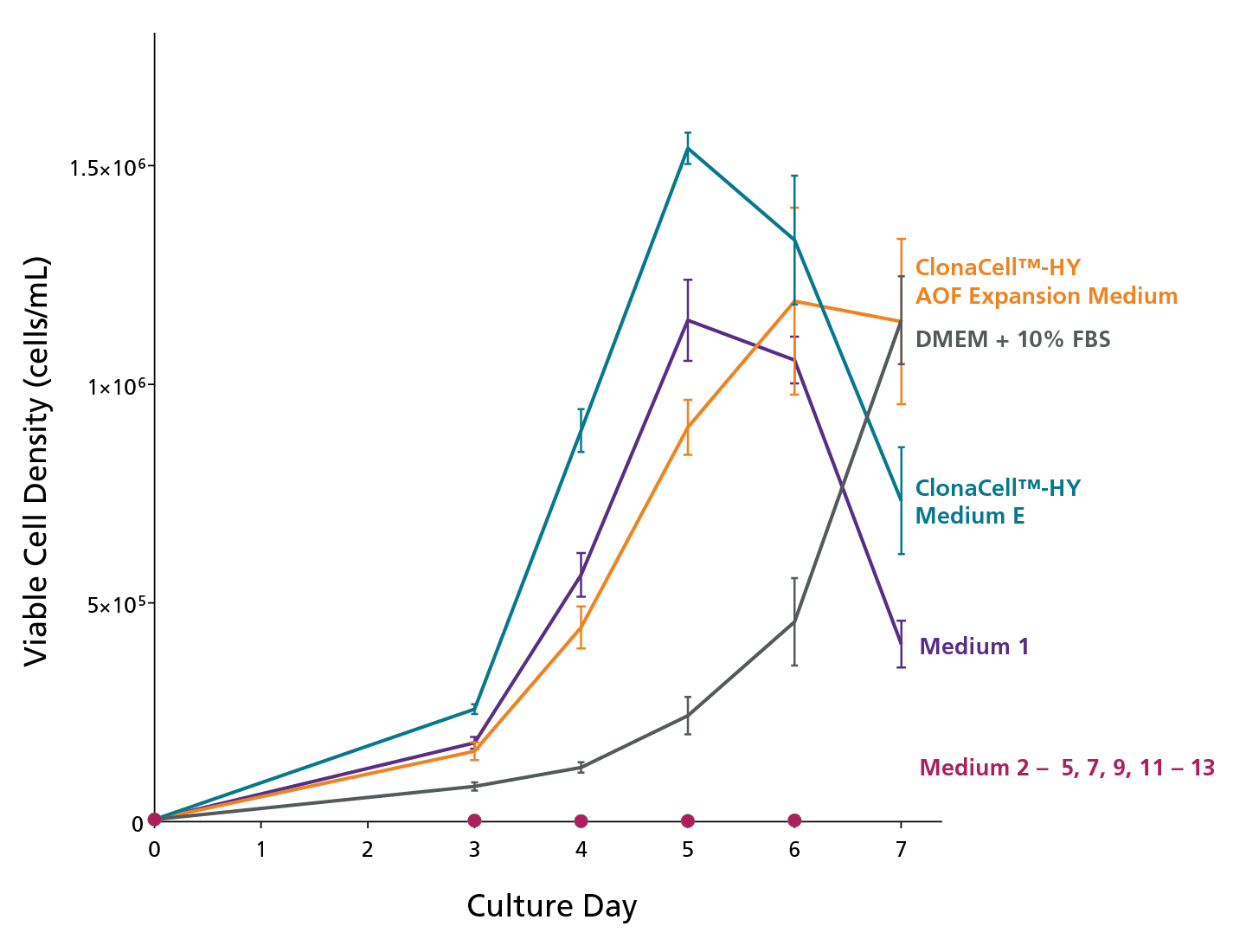
Graph comparing growth of hybridoma cell line expanded in commercially available serum-containing and serum-free hybridoma cell culture media.

Figure 2. Expansion of an Established Hybridoma Cell Line in Several Commercially-Available Serum-Containing and Serum-Free Hybridoma Cell Culture Media

The hybridoma line was adapted to growth in 13 different cell culture media: ClonaCellTM-HY AOF Expansion Medium (animal origin-free), DMEM + 10% FBS or ClonaCellTM-HY Medium E (serum-containing), Medium 1 (serum-free with serum-derived proteins), Medium 2 – 4 (serum-free), Medium 5 (animal component-free), Medium 7, 9 (protein-free), and Medium 11 – 13 (chemically-defined). They were then seeded in triplicate in 24-well tissue culture plates at 5 x 10³ cells/mL. The cultures were incubated at 37°C (5% CO2 atmosphere) and the viable cell density was measured on days 3 – 7. Data is expressed as mean ± 1SD.

产品说明书及文档

请在《产品说明书》中查找相关支持信息和使用说明,或浏览下方更多实验方案。

Document Type
Product Name
Catalog #
Lot #
Language
Catalog #
03835
Lot #
All
Language
English
Document Type
Technical Manual
Catalog #
03835
Lot #
All
Language
English
Document Type
Safety Data Sheet
Catalog #
03835
Lot #
All
Language
English

应用领域

本产品专为以下研究领域设计,适用于工作流程中的高亮阶段。探索这些工作流程,了解更多我们为各研究领域提供的其他配套产品。

相关材料与文献

文献 (1)

MUC13 negatively regulates tight junction proteins and intestinal epithelial barrier integrity via protein kinase C C. Segui-Perez et al. Journal of Cell Science 2024 Mar

Abstract

Glycosylated mucin proteins contribute to the essential barrier function of the intestinal epithelium. The transmembrane mucin MUC13 is an abundant intestinal glycoprotein with important functions for mucosal maintenance that are not yet completely understood. We demonstrate that in human intestinal epithelial monolayers,MUC13 localized to both the apical surface and the tight junction (TJ) region on the lateral membrane. MUC13 deletion resulted in increased transepithelial resistance (TEER) and reduced translocation of small solutes. TEER buildup in ΔMUC13 cells could be prevented by addition of MLCK,ROCK or protein kinase C (PKC) inhibitors. The levels of TJ proteins including claudins and occludin were highly increased in membrane fractions of MUC13 knockout cells. Removal of the MUC13 cytoplasmic tail (CT) also altered TJ composition but did not affect TEER. The increased buildup of TJ complexes in ΔMUC13 and MUC13-ΔCT cells was dependent on PKC. The responsible PKC member might be PKCδ (or PRKCD) based on elevated protein levels in the absence of full-length MUC13. Our results demonstrate for the first time that a mucin protein can negatively regulate TJ function and stimulate intestinal barrier permeability.

更多信息

更多信息
物种 人, 大鼠, 小鼠
Contains • Hypoxanthine and thymidine (HT) • Gentamicin • Phenol red • L-Glutamine and other supplements • Other ingredients, including recombinant proteins
配方 无血清

质量声明:

产品仅供研究使用,不用于针对人或动物的诊断或治疗。 欲获悉更多关于STEMCELL的质控信息,请访问 STEMCELL.CN/COMPLIANCE.

Copyright © 2026 by STEMCELL Technologies. All rights reserved.

在线联系